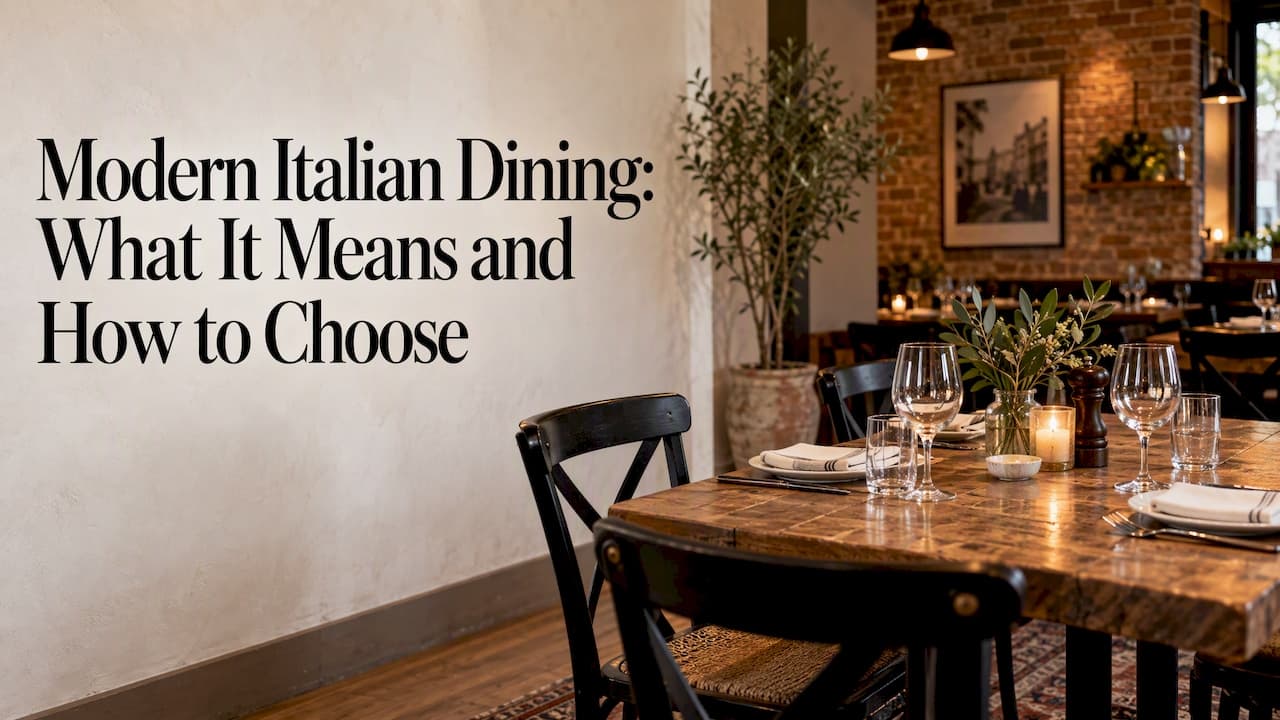
Modern Italian dining is Italian cooking that keeps the foundations (good pasta, good olive oil, respect for the ingredient) and drops the rulebook. The menu follows the season and the cook's own experience instead of one region's script, and the room feels relaxed instead of formal. If you live around Haddon Township, Haddonfield or Collingswood, this guide explains what the label means and how to choose a place for the night you have in mind. It also shows how we cook at Duo.
TL;DR
- "Modern" tells you what a menu is not (a fixed red-sauce script) more than what it must be, so read the menu, not the label.
- Look for scratch-made pasta, seasonal produce and seafood, and a short list of well-sourced staples.
- Atmosphere matters as much as food: modern Italian usually means warm, casual and unfussy, not white tablecloths.
- Match the room to the occasion: quieter tables for dates, shareable plates for groups, approachable entrees for families.
- At Duo in Haddon Township we cook in a true scratch kitchen, with seafood from Long Beach Island when available, a full bar and 18 craft beers on tap.
Table of Contents
- What modern Italian dining means in the US
- Modern, traditional and red-sauce Italian: how they differ
- What is on the plate: ingredients and technique
- The room: what the atmosphere feels like
- How to choose for your occasion
- Perspective
- Eating modern Italian at Duo
- Book a table at Duo
- FAQ
- Sources
What modern Italian dining means in the US
There is no official definition, and that is part of the appeal. Chef Rocco DiSpirito has described the current moment in the US as a "post-Renaissance" period with plenty of Italian-American and traditional Italian food, ingredients and know-how, and food that sits closer to Italy's than it used to.
Philadelphia, our neighbor across the river, offers a useful picture. A recent report on the city's newest generation of Italian American chefs says they treat the word "modern" as a tool that gives them freedom to write their own menus. It signals to diners what the food is not, namely strictly traditional red-sauce cooking, instead of fencing in what it has to be.
In practice, a modern Italian restaurant usually has these traits:
- A scratch kitchen. Pasta, sauces and sides are made in the building, not assembled from a catalog.
- A seasonal menu. Dishes change with what is good right now.
- A looser attitude to tradition. Classics appear, but so do dishes that borrow from other cuisines.
- A bar that matters. Cocktails, wine and beer are part of the meal, not an afterthought.
- A relaxed room. You can come in after work or dress up for an anniversary, and either feels right.
Modern, traditional and red-sauce Italian: how they differ
These labels overlap, but each sets a different expectation. Italian-American cooking is built primarily on the traditions of Southern Italian immigrants, and many of us grew up on it: big portions, red gravy, family-style trays. Regional Italian cooking in Italy is narrower and more local. Modern Italian sits between and beyond them.
| Classic red-sauce | Regional Italian | Modern Italian | |
|---|---|---|---|
| Menu logic | Familiar standards, rarely changing | One region's dishes | Seasonal, chef-driven |
| Pasta | Often large, sauce-heavy | Shape matched to the local sauce | Housemade, often lighter, shapes chosen by the cook |
| Influences | Southern Italian immigrant cooking | The region itself | Italian base plus other techniques |
| Room | Traditional, often formal or nostalgic | Varies | Warm, casual, contemporary |
| Best for | Sunday-dinner nostalgia | Purists | Date nights, groups, regulars |
None of these is better in every way. The point is to know what you are in the mood for. The Philadelphia report notes that today's chefs move beyond traditional red-sauce restaurants and fold in personal, biographical influences. Another profile quotes a chef saying that red-sauce Italian-American food has become a genre of its own, which each chef then interprets through personal experience.
You will also see menus billed as "Northern Italian." John Mariani, writing in Forbes, notes that in the US this label was often a marketing device to separate a menu from red-sauce cooking, without real regional authenticity, and that more genuine regional representation is now a growing trend. A good rule: trust the cooking on the plate more than the region on the cover.
What is on the plate: ingredients and technique
A short list of staples done well
Modern does not mean abandoning the pantry. Chefs interviewed about high-end Italian cooking in the US name extra-virgin olive oil, DOP San Marzano tomatoes and 24-month aged Parmigiano-Reggiano as core pillars. When a menu is built on a handful of excellent staples, a simple bowl of pasta can be the best thing you eat all week.

Lighter, cleaner, a little unexpected
The same shift shows up in classic dishes. Food & Wine describes a risotto renaissance in which some chefs use light vegetable broth or even water and reach for olive oil or vegetable emulsions for creaminess, with carnaroli a commonly used rice. The theme is simplicity and lightness: the dish tastes more like its ingredients.
Techniques travel too. In the American scene, chefs often borrow French, Spanish or even Asian ideas, such as Thai flavors or Basque peppers, to build menus that reflect their own lives. Italian critics make a similar point about Italy itself: better training, better products and precise modern tools have raised the overall level of Italian cooking.
What does that mean when you read a menu? Look for signs of care:
- Pasta described as housemade, with a sauce that fits the shape.
- A seafood or vegetable dish tied to the season, not a fixed year-round list.
- A few unexpected touches, such as chili, citrus or a pickled element, that sharpen a rich dish.
- Desserts and sides that also come from the kitchen, not a freezer.
Seasonal beats regional
Rather than championing one Italian region, many modern chefs prefer a seasonal, flexible approach that responds to local climate and what is available. For a South Jersey kitchen, that has a very local meaning: tomatoes and corn in summer, squash and greens in fall, and seafood that comes from the Jersey Shore. We buy seafood from Long Beach Island when it is available, and the menu moves with it.

The room: what the atmosphere feels like
Modern Italian dining is as much about the room as the plate. Interiors range widely. One New York Times piece describes a neon-stippled dining room that references the Memphis Group design movement of the 1980s, which shows how far the genre can stretch from checkered tablecloths.
Most neighborhood spots take a gentler route: warm lighting, wood and brick, an open bar, music you can talk over. Our own room at Duo is modern-rustic and meant to feel welcoming without formality. You can see it on our photos page before you come.
How to choose for your occasion
The best modern Italian restaurant is the one that fits the night. Here is a practical way to decide.
Date night
Look for a menu with a few shareable starters, handmade pasta and a wine list that has real range by the glass. Ask for a table away from the bar if you want quiet, or sit at the bar if you want to watch the cocktails being made. Seafood-forward dishes and a signature cocktail make an easy, romantic pairing.
Family dinner
Families need flexibility. Check that the menu has approachable entrees alongside the more adventurous plates, and that the kitchen is comfortable adjusting a dish. Pasta is the natural common ground: a simple housemade shape with a good sauce satisfies a picky eater and an adult in the same sitting.
A casual night with friends
Small plates and a beer list are the best signs. Sharing a few plates, ordering another round and staying a while is the point. Draft beer variety matters here: we pour 18 craft beers on tap, so a group with different tastes can all find something.
Larger gatherings
For birthdays, rehearsal dinners or work events, ask about private space, set menus and per-person pricing up front. A set menu keeps the bill predictable and the kitchen on time. We describe our options in the private dining section below.
A quick checklist before you book
- Read the current menu online: does it change with the season?
- Look for the words housemade or scratch, and ask what is actually made in-house.
- Check the bar: cocktails, wine by the glass, beer.
- Look at photos for the mood of the room.
- Ask about group seating and private options if you are more than six.
- Check for a happy hour if you want a lighter, lower-cost visit.
Perspective
We opened Duo in Haddon Township in 2026 with a simple idea: a neighborhood restaurant should cook the way you would if you had the time. That is why we make nearly everything in-house, from pasta to sauces, in a true scratch kitchen.
To us, "modern Italian" does not mean complicated. It means honest cooking with fresh, seasonal ingredients, and the freedom to follow what is good this week, including seafood from Long Beach Island when we can get it. It means premium domestic meats, handcrafted pasta and creative small plates sitting next to approachable entrees, so that a first date and a family birthday can both feel at home.
We come from the same team behind Il Villaggio in Cherry Hill, and we are family-owned. We want you to walk in and feel like a regular by the second visit: a signature cocktail at the bar, a glass from a curated wine list, a cold craft beer, and a table where nobody is rushing you. Our room is warm and modern-rustic, and our service is meant to be easy and welcoming.
That is the version of modern Italian dining we believe in, and it is what we cook every night.
Jay
Eating modern Italian at Duo
Here is how the ideas above translate to our menu and prices. Prices are as published on our site, and the pages linked below carry the current details.
The a la carte experience
Our full menu covers housemade pastas, seasonal seafood, premium domestic meats and small plates. Come with friends and share several plates, or order your own pasta and an entree.
Happy hour and the bar
If you want a casual first visit, our happy hour menu is an easy start. Signature cocktails are $10-12, wines by the glass are specials at $8, and plates and bites are $12.
The Chef's Menu
For an evening where you hand over the decisions, the Chef's Menu is $98 per person. It is a good fit for anniversaries and food lovers who want to taste the range of the kitchen.
Private dining and event menus
We host small private gatherings and larger parties in our private dining space. Published event pricing starts with Event Menu 1 at $36 per person and Event Menu 2 at $51 per person. We also offer an Elegant Cocktail Reception at $51 per person, an Event Menu 3 at $63 and a Signature Cocktail Reception at $63. For group size, timing and availability, ask us directly.
Book a table at Duo
If you are in Haddon Township, Haddonfield, Collingswood, Oaklyn, Audubon, Haddon Heights or nearby, we are your neighborhood Italian: scratch-made, seasonal and relaxed. Pick a night, bring whoever you like, and let the kitchen show you what modern Italian can taste like. You can reserve a table online, and gift cards are available from our home page for anyone who would rather give the evening as a present.

We also suggest walking in for happy hour if you want to see the room first before planning a longer dinner.
FAQ
What is the difference between modern Italian and Italian-American food?
Italian-American food grew from the traditions of Southern Italian immigrants and is known for hearty red-sauce dishes. Modern Italian keeps the Italian foundation but follows the season and the chef's own influences. Many menus mix both, so the dishes tell you more than the label.
Is modern Italian dining formal?
Usually not. Most modern Italian restaurants aim for a warm, casual room where you can dress up or dress down. At Duo, we designed the space to feel welcoming and unfussy, whether you come for a drink at the bar or a long dinner.
What should I order at a modern Italian restaurant?
Start with housemade pasta, since it shows what a scratch kitchen can do. Then add a seasonal seafood or vegetable dish and one or two small plates to share. Ask your server what is freshest that week, because modern menus often change with the season.
Can I book a private gathering near Haddonfield?
Yes. We host private gatherings at Duo in Haddon Township, with event menus priced per person. See our private dining page for the options, then contact us about your date and group size.
Sources
- Rocco DiSpirito On the State of Italian Food in America
- The Chefs Defining Philly's New Italian American Cuisine
- Talking San Sabino with Angie Rito and Scott Tacinelli
- How Italian Chefs Are Reinventing Risotto
- Young chefs have improved Italian cuisine
- Why Don't More U.S. Italian Restaurants Serve More Regional Italian Food?
- New York Italian Food Is Getting Weird (in a Good Way)
- Italian-American cuisine