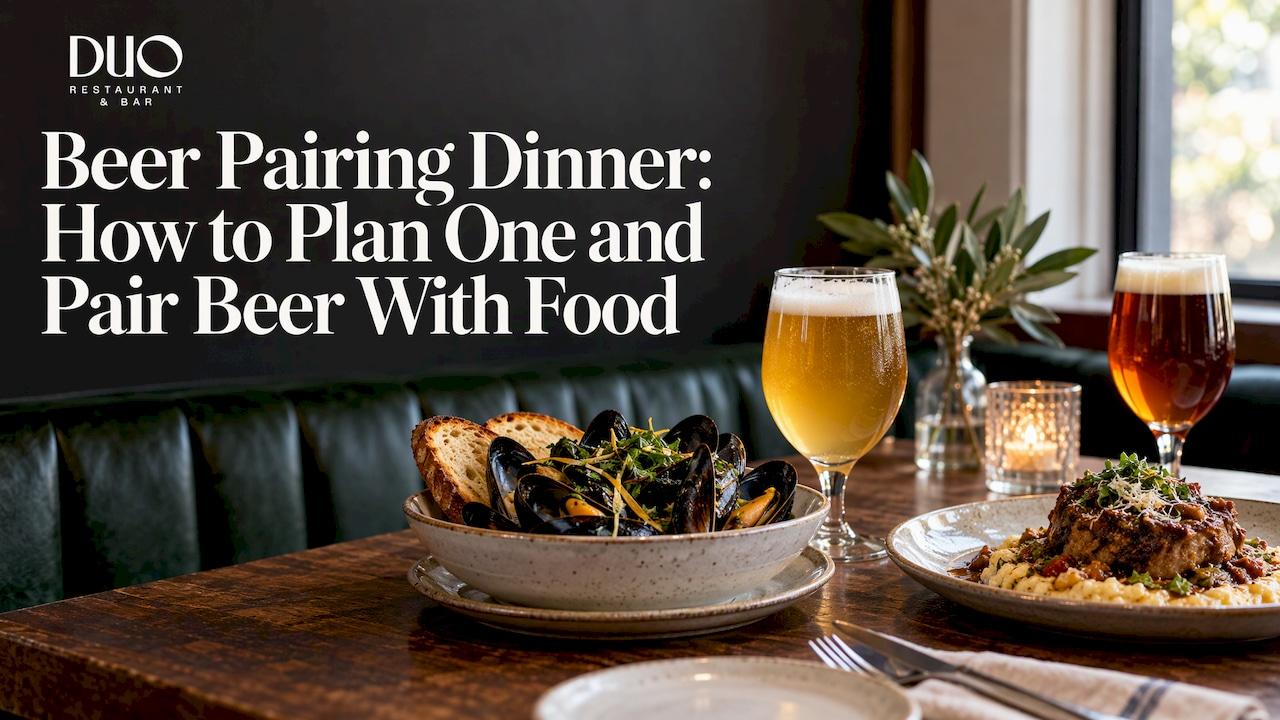
A good beer pairing dinner comes down to a few habits: match the strength of the beer to the strength of the dish, pour lighter beers first and darker ones later, and let bitterness, bubbles or sweetness do the balancing. You can follow those habits at home, at a brewery event, or on an ordinary Tuesday night at a table with friends.
We're a family-owned scratch kitchen in Haddon Township, and beer is a real part of how our guests enjoy dinner. With 18 craft beers on tap, there is plenty to explore. Below is a practical guide to planning a beer pairing dinner, followed by how we think about beer at Duo.
TL;DR
- Match intensity: delicate dishes want lighter beers, bold and rich dishes want beers with more body, bitterness or roast.
- Use both contrast and complement: every good pairing needs some of each, with one doing more of the work.
- In a multi-course dinner, start light and finish dark, and serve beer cool but not ice cold.
- Build the pairing around how the dish is cooked and its main ingredient, then consider the sauce.
- At Duo you can order from 18 craft beers on tap alongside scratch-made Italian dishes and find a favorite for your plate.
Table of Contents
- What a beer pairing dinner actually is
- The principles that make pairings work
- Which beer goes with which kind of dish
- Planning a multi-course beer pairing dinner
- Keeping it friendly for every guest
- Beer and Italian food: how we think about it
- Beer at Duo: a neighborhood way to do it
- Plan your night with us
- FAQ
- Sources
What a beer pairing dinner actually is
A beer pairing dinner is a meal where each course is served with a beer chosen to suit it. Breweries and restaurants often host them as set-menu events, but the idea works at any table. The goal is that the food makes the beer taste better and the beer does the same for the food.
The Cicerone program's guide to American craft beer and food makes a point worth repeating: because beer is grain-based, it is a food in itself, and its range of flavors, aromas and textures suits almost any cuisine, from a handmade sausage to a gourmet plate. That is why beer deserves a place at a proper dinner, not only beside the game.
The classic format runs like this: a light, bright beer with a starter, something amber or malty with the main, and a dark, roasty beer with dessert. Craft Beer & Brewing describes witbier with steamed mussels, amber ale with barbecued ribs and robust porter with chocolate molten lava cake as the classic light-to-dark arc.

The principles that make pairings work
You don't need to memorize a chart. You need a handful of ideas you can apply to any dish.
Match strength with strength
The Cicerone guide lists matching strength with strength, finding harmonies, and weighing sweetness, bitterness, carbonation, heat and richness among its core ideas. A delicate piece of fish disappears next to a big imperial stout. A rich braise flattens a light lager. The Oxford Companion to Beer says beer intensity comes from a mix of sweetness, maltiness, bitterness, roast, alcohol, carbonation and sometimes acidity, and that judging it is as natural as setting the volume for a dinner party.
Contrast and complement
A complementary pairing echoes a flavor: roasty beer with a dish that has char or caramelized notes. A contrasting pairing cuts against it: a crisp, fizzy beer against something fatty. The Cicerone guide says all pairings should involve both contrast and complement, though some lean harder on one than the other.
Pairing expert Wille, quoted by eCornell, puts the habit simply: look for harmonies, and when the food is fatty, cut it with something acidic, light or fizzy.
Five qualities to check
WSET names bitterness, carbonation, heat, richness and sweetness as the five qualities to consider. Carbonation can cut through richness and refresh your palate between bites, and malty sweetness can cool the heat of a spicy dish. Keep those five in mind and most decisions get easier.

Start with the cooking method
Another eCornell expert, Miller, suggests keying a pairing to how the food is prepared and its main component: fried food carries more fat, grilled food brings smoke, and the sauce comes in after that. It is a sound way to think about a plate of pasta too. Ask what the dish is built on, then what the sauce adds.

Which beer goes with which kind of dish
Here is a quick reference built from published guidance. Treat it as a starting point and trust your own palate.
| Dish type | Beer styles to try | Why it works |
|---|---|---|
| Rich, fatty or fried | American Black Ale or English-style Brown Porter | Hoppy, bitter or roasty beers cut through fat and leave a complex finish |
| Shellfish | Belgian-style Saison or German-style Hefeweizen | Brings out salinity and natural sweetness while cleansing the palate |
| Rice and other grains such as arborio | American Amber Lager or Bohemian-style Pilsner | Clean, balanced beers that suit mild, creamy dishes |
| Rich meats and root vegetables | American Brett or Belgian-style Flanders | Sour, tart and funky beers bring out umami and add earthy notes |
| Spicy dishes | Pale ales and IPAs | Bitterness can intensify flavors without clashing |
| Grilled chicken | Saison | A classic pairing listed by WSET |
| Steak | Porter | Roast and body stand up to the meat |
| Chocolate dessert | Stout | Roasted notes echo the cocoa |
A few more ideas from the same sources. A bitter beer can cut the richness of pork fat, a roasted beer can balance a sweet dessert, and a sour beer can intensify the earthiness of root vegetables. SUNY Geneseo notes that nut brown ales go well with cheese, grilled meats or hearty stew, and that coconut ales suit seafood dishes.
Planning a multi-course beer pairing dinner
If you are hosting, a little structure goes a long way. Here is a simple order of work.
- Taste the beers first. Pairing expert Lodge says he always starts with the beer, tasting it before bringing in food. Know what each beer actually tastes like before you commit it to a dish.
- Map the arc of the meal. Epicurious advises starting with a light beer and working toward darker ones when you pair course by course. Build intensity as the meal goes on so each course doesn't flatten the one after it.
- Choose the dish, then the beer. Decide the cooking method and the main ingredient, then use the principles above to shortlist styles.
- Keep portions sensible. If a beer is strong in alcohol, pair it with something substantial. Lodge notes that very strong beers paired with small portions of light fare can be hazardous, so give bigger beers bigger food.
- Mind the temperature. Epicurious puts the ideal serving range at 40°F to 50°F. WSET adds that too cold dulls flavor and aroma, and too warm lets bitterness fade and carbonation drop.
- Think about the season. The Cicerone guide encourages light food and beer in summer and heavier beer in winter. Craft Beer & Brewing points to fall as the time for pumpkin beers with strong blue cheese and toasty Oktoberfest lagers with spicy sausage.
A sample four-course arc
Here is how that might look on paper. It's an illustration of the method, not a menu we serve.
- Starter: something crisp and light, like a pilsner or a wheat beer, with a salad or seafood.
- Pasta course: a clean amber lager or a saison, depending on whether the sauce is creamy or bright.
- Main: a malty amber or a porter if the dish is grilled or braised.
- Dessert: a roasty stout or porter with anything chocolate.
The lighter styles are a natural fit for lighter foods. Craft Beer & Brewing notes that Pilsner, Hefeweizen and wheat beer suit salads, seafood and chicken.
Keeping it friendly for every guest
Not everyone at the table likes the same thing, and that is fine. WSET points out that individual palates perceive salt, acidity, bitterness, sweetness and umami differently, and that preferences shift with generation, background and adventurousness. Some guests love classic combinations, others enjoy a surprise.
A few ways to make the table comfortable for everyone:
- Offer small pours so guests can taste without committing to a full glass.
- Include at least one easygoing beer on the lineup, a lager or an amber, alongside the bolder ones.
- Keep one sweeter or fruitier option for guests who find bitterness hard going.
- Let guests swap. Passing glasses around is half the fun.
The best pairing is the one your guests enjoy, and a little curiosity beats a rulebook.
Beer and Italian food: how we think about it
Italian cooking is built on balance: acidity from tomato, richness from cheese and olive oil, salt from the sea, sweetness from slow-cooked onion. Those are the same levers the pairing guides describe. A tart beer can lift something rich, a bitter one can cut through it, and a malty one can sit comfortably beside roasted flavors.
Here is how the guidance translates to the kinds of dishes you'll find in a scratch Italian kitchen. These are our suggestions for how to think, not a fixed list.
- Seafood. Fish and shellfish suit light, lively beers. The published guide points to saison and hefeweizen for shellfish, and we've found that the same instinct works for seafood in general.
- Creamy or rice-based dishes. The craft beer guide pairs arborio rice with amber lager or Bohemian-style pilsner, clean styles that let a creamy plate shine.
- Rich, savory dishes. Reach for something with a little bitterness or roast to cut through the richness.
- Grilled meats. Malty browns and porters, as above, echo the char.
- Dessert. A roasty dark beer is a lovely finish.
Perspective
We opened Duo because we love feeding people, and we have always believed beer belongs at the Italian table. Our kitchen is scratch-made, our ingredients are fresh and seasonal, and our tap list gives you 18 craft beers to choose from. That range means the person who wants something light and crisp and the person who wants something dark and roasty can both find their glass without leaving their seat.
We don't run a set beer-pairing menu, and we like it that way. Dinner here is meant to be relaxed. Anyone who enjoys good food and good beer can find a great beer to go with their selection at Duo, and our team is always happy to talk through what's pouring and what you're hungry for. Think about what you're ordering, whether it's rich, bright, grilled or creamy, and pick the beer that suits the mood.
Come hungry, try something you haven't had before, and let the table decide the favorites.
Jay
Beer at Duo: a neighborhood way to do it
If you like the idea of a beer pairing dinner but want it without the formality, a neighborhood restaurant with a deep tap list does the job nicely. At Duo you can start with a drink, share a few plates and let the meal build the way you like. If you want to explore other drinks too, our happy hour menu lists signature cocktails at $10-12, wine by the glass at $8 and plates and bites at $12. Prefer wine with dinner? Our guide to a wine pairing dinner with Italian food covers the same ideas, and our piece on food and cocktail pairing does the same for the bar.
Plan your night with us
Whether it's a date night in Haddon Township, dinner with friends from Haddonfield or Collingswood, or a casual group gathering, we would love to have you. Browse our full menu, pick what you're craving and choose a beer from the tap list to go with it.

Planning something bigger? Our event menus are priced per person: Event Menu 1 is $36, Event Menu 2 is $51 and the Chef's Menu is $98. You can read about private dining for small gatherings, or make a reservation for a regular night out.
FAQ
Does Duo host beer pairing dinners?
We don't offer a set beer-pairing menu. What we do have is a tap list of 18 craft beers and a scratch-made Italian menu, so anyone who enjoys good food and beer can find a great beer to go with their selection. Our team is happy to point you toward something that suits what you order.
What beer goes best with pasta?
It depends on the sauce. Clean, balanced styles such as amber lager or Bohemian-style pilsner are recommended for grain-based dishes like arborio rice, and the same logic suits creamy pasta. For richer, heartier sauces, look for more malt, bitterness or roast.
What is the golden rule of beer and food pairing?
Match the intensity of the beer to the intensity of the dish. The Cicerone guide recommends matching strength with strength, then looking for both harmony and contrast. Delicate food goes with lighter beer, and bold food goes with bolder beer.
In what order should beers be served at a multi-course dinner?
Start light and move toward darker beers. Epicurious advises beginning with a light beer and working toward darker ones, which keeps each course from overwhelming the next. Serve them cool, in the 40°F to 50°F range.
What beer pairs well with seafood?
Light, lively styles tend to work best. For shellfish, the craft beer guide suggests saison or hefeweizen, which bring out salinity and sweetness and cleanse the palate. SUNY Geneseo also notes that coconut ales pair with all types of seafood.
Sources
- Designing a Beer-and-Food Paired Menu, Craft Beer & Brewing
- American Craft Beer and Food, Cicerone
- The Perfect Match: Pairing Beer with Food, eCornell
- How to create the best beer and food pairings, WSET
- Food pairing, The Oxford Companion to Beer
- Craft Beer & Food Pairing Guide
- Beer and Food Pairings: 16 Menu Ideas, Epicurious
- Beer + Dinner 101, SUNY Geneseo