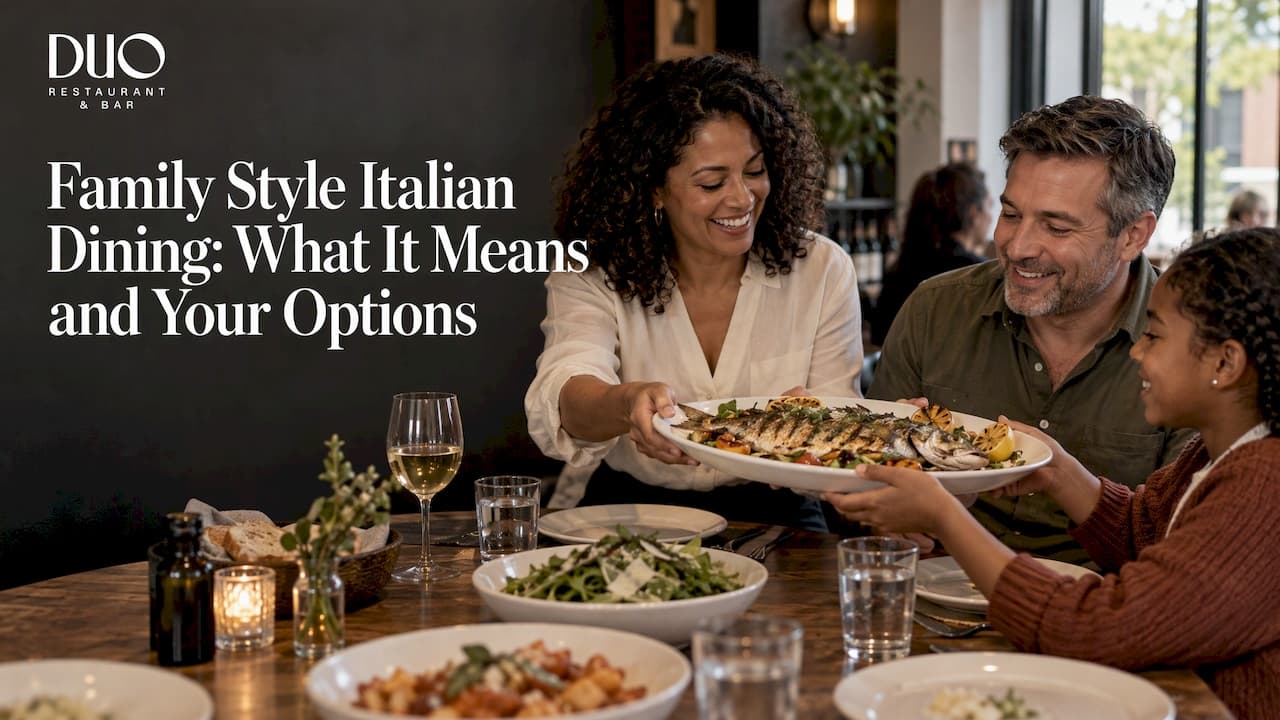
Family style Italian dining means food arrives at the table on big platters and bowls, and everyone passes and serves themselves instead of getting an individual plate. It is a lovely way to eat, and it comes from a real tradition. At Duo Restaurant & Bar in Haddon Township, we do not serve family style platters. What we do serve is easily sharable food: housemade pastas, creative small plates and seasonal seafood that your table can pass, split and swap, with each person still choosing what they want.
Below, we explain what family style really is, how an Italian meal is built, how it differs from sharing plates, and how to get that communal feeling at a neighborhood spot near you.
TL;DR
- Family style means large platters placed in the center of the table and passed around, rather than individually plated entrees.
- Duo does not offer family style dishes. We do offer easily sharable dishes, so your table can pass plates and taste a little of everything.
- A traditional Italian meal runs antipasti, primi, secondi, contorni and dolci, and sharing often starts with the antipasti.
- For groups, we offer private dining and set event menus from $36 per person.
- Date night, friends' night out or a larger gathering: choose by how much you want to share and how much you want your own plate.
Table of Contents
- What family style Italian dining actually means
- How an Italian meal is built
- Why people love eating this way
- Family style vs. sharable dishes: what we do at Duo
- Perspective: why we cook for sharing, not for platters
- Which kind of dinner fits your night
- Group dining at Duo
- What to look for in any Italian restaurant that shares well
- Come eat with us in Haddon Township
- FAQ
- Sources
What family style Italian dining actually means
In restaurant terms, family style dining is food brought out on large platters or serving dishes rather than individually plated, with guests serving themselves as the dishes are passed around the table. The idea echoes the home-cooked meal around the kitchen table, where nobody orders and everybody eats from the same dishes.
Italian food suits this style naturally. According to FSR magazine, family-style eating in Italy is a way of life, with loved ones gathered around a big roast, a heaping plate of pasta or a whole grilled fish with simple sides. The Daily Meal makes a similar point, noting that family-style service at Italian restaurants mirrors the cultural emphasis on community and sharing food, turning a solo-focused meal into something where passing trays sparks connection.
How it differs from individually plated service
With plated service, each guest orders one dish and receives it on their own plate. With family style, the table (or the host) chooses a set of dishes, the kitchen sends them out in large portions, and the group serves itself. A few practical differences follow:
- Ordering: family style is often a fixed menu priced per person, with a set number of choices per course. Plated service is order-by-order.
- Portions: platters are sized for several people, so you eat a little of many things instead of a lot of one thing.
- Pacing: dishes tend to arrive together or in waves, so the table eats at the same moment.
- Choice: you share the decisions. If one person wants something light and another wants something rich, a fixed family style menu can't always give both.
That last point is why many neighborhood restaurants, including us, favor a looser approach.
How an Italian meal is built
Knowing the structure of the meal makes sharing easier, whether you are at a restaurant or cooking at home. According to Food & Wine, a sit-down meal in Italy follows a format of antipasti, primi (pasta or rice), secondi (meat or fish), contorni (sides) and dolci (desserts). If you are with a group, it is common to order a few antipasti to share family style, while each person gets their own pasta or main course.
That is a useful model, and it is close to how many of our guests like to eat with us. Here is what each course typically does:
| Course | What it is | How tables usually share it |
|---|---|---|
| Antipasti | Starters and small bites | Order a few for the whole table and pass them around |
| Primi | Pasta, risotto, soup | One per person, with forkfuls traded across the table |
| Secondi | Meat or fish mains | Usually individual, sometimes split between two |
| Contorni | Side dishes | Shared, and meant to go with the secondo |
| Dolci | Dessert | Order a couple and pass spoons |
One small etiquette note from the same Food & Wine piece: author Maria Pasquale says that if you want to eat like the locals, a contorno goes with the secondo, not the primo. It is a charming detail, and a good reminder that Italian sharing has its own rhythm.

Why people love eating this way
The appeal is simple. Everyone gets to taste more, nobody waits for their entree while someone else eats, and the table becomes a conversation. The Daily Meal notes that this style is especially fun when part of your party is kids, because passing a taste of the old country around the huddle is interactive and less stressful for all ages. It also works well for large families and groups, since large trays of lasagna or spaghetti are often a more economical way to feed everyone.
Those are real strengths of the format, and the instinct behind them is the one we share: good food tastes better when it is part of a conversation.

Family style vs. sharable dishes: what we do at Duo
We want to be completely clear here, because it is one of the most common questions we hear: Duo does not offer family style dishes. We do not bring out oversized platters of pasta or trays of entrees sized for the whole table.
What we do have are easily sharable dishes. Our kitchen is a true scratch kitchen, preparing nearly all of our menu in-house, and our menu includes handcrafted pastas, creative small plates, approachable entrees and seasonal seafood. These are dishes you can set in the middle of the table, pass around and taste together, while everyone keeps a plate that is theirs.
That gives you the best of both worlds:
- You pick your own dish. Nobody has to compromise on a fixed set menu.
- You still share. Order a few plates for the table, trade forkfuls of pasta, and split dessert.
- You control the pace. Start with small plates and decide what comes next as you go.
If you would like to browse before you come, our full menu is online. Our photos page shows the room and the food.
How to share a meal at Duo
Here is a simple way to build a shared dinner for a table of four:
- Start with two or three small plates for the table. We offer plates and bites at $12 on our happy hour menu, a good way to sample.
- Choose a pasta each, and pass bites around. Housemade pasta is made for forkfuls swapped across the table.
- Add one or two entrees to split, especially if seafood from Long Beach Island is available that day.
- Finish with a dessert or two and pass the spoons.
A useful rule when you share: order a little fewer dishes than one per person per course, then add more if the table is still hungry. It is easier to add a plate than to stare at one you could not finish.
Perspective: why we cook for sharing, not for platters
Opening Duo has been a heartfelt new venture for our family, from the same team behind Il Villaggio in Cherry Hill. We grew up around tables where everyone reached across everyone else, and we wanted that feeling in our dining room.
But we chose to write our menu around the individual guest. Every pasta is handcrafted in our kitchen, and every plate is meant to be enjoyed on its own or passed across the table. That means the person who wants a lighter dinner and the person who wants a rich one can sit side by side, and both leave happy.
To us, that is what makes a neighborhood spot: warm, unfussy, and easy to share. Come hungry, leave inspired.
Jay
Which kind of dinner fits your night
The right style depends on who is at the table and what kind of evening you want.
Date night
Two people rarely need platters. A few small plates, one pasta each and a shared dessert gives you variety without waste. A glass of wine from our curated list, or one of our signature cocktails, rounds it out. Our signature cocktails run $10 to $12, and our by-the-glass wine specials are $8 a glass, per our happy hour menu.
Friends gathering for dinner
For four to six friends, sharing is the whole point. Start with several small plates, add a pasta each and pass freely. With 18 craft beers on tap and a full bar, the table can mix and match drinks as easily as plates.
Families
Families often like the idea of platters because of the variety and the lack of fuss. Our approach for a family is simple: order a few shared plates to start so everyone can taste, then let each person choose a pasta or entree that suits them. Picky eaters and adventurous ones can both be happy, because nobody is committed to the same dish.

Larger groups
When you are past eight or ten people, ordering one by one gets slow. That is where a set menu helps. A guide on casual group dining suggests defining your headcount and target cost per person, flagging allergies and dietary needs in advance, confirming the final headcount a day or two ahead, and asking about service charges for large groups. Those are sensible steps wherever you book, and we are glad to talk through them with you.
Group dining at Duo
If your table is a birthday, a rehearsal dinner or a team gathering, our private dining option and fireplace dining room are made for it. The per-person menus below are what we publish:
| Menu | Price per person |
|---|---|
| Event Menu 1 | $36 |
| Event Menu 2 | $51 |
| Elegant Cocktail Reception | $51 |
| Chef's Menu | $98 |
We also offer Event Menu 3 and a Signature Cocktail Reception at $63. Details for private events, including the menu choices, are on our private events page. If you are weighing options for a bigger party, thinking through catering for a larger group can help you get the headcount, budget and timing right before you book.
To make a group dinner go smoothly, we suggest you:
- Tell us the headcount and the occasion when you reach out.
- Share any allergies, vegetarian or gluten-free needs early, so the kitchen can plan.
- Confirm your final number a day or two ahead.
- Ask us about pairing food with wine if you want a more curated evening. Our guide to planning a wine pairing dinner is a good start.
What to look for in any Italian restaurant that shares well
Whether you are visiting us or somewhere else in South Jersey, a few signs tell you a kitchen is good at food made for passing:
- Real scratch cooking. Pasta made in-house holds up to sharing and tastes better from the middle of the table.
- A menu divided in the Italian way. When antipasti, primi and secondi are clearly separated, it is easy to order a little of each.
- Flexible portions. FSR magazine describes restaurants that use smaller pasta portions so groups can try three or four dishes, and that idea carries over to any table that wants variety.
- Seasonal ingredients. Seasonal produce and fish change what is best that week, which makes sharing more fun. We source seafood from Long Beach Island when it is available.
For a wider look at how a contemporary Italian kitchen thinks about all of this, see our piece on modern Italian dining.
Come eat with us in Haddon Township
We are a family-owned neighborhood restaurant, open since 2026, serving guests from Haddon Township, Haddonfield, Collingswood, Haddon Heights, Audubon, Oaklyn and beyond. If you love the idea of sharing a table, our menu was written for it, with every dish easy to pass and nobody stuck with a plate they did not choose.
Bring friends, bring a date, or bring the whole family. Start with small plates, order a handcrafted pasta, and see what is fresh from the shore. You can look at our menu, plan a group event through our private dining page, or give a gift card to someone who loves Italian food through our site.

FAQ
What is Italian family style?
Italian family style means large platters of food are placed in the middle of the table and guests serve themselves, passing dishes around. It reflects the way many Italian families eat at home, with pasta, roasts and sides shared by everyone. Restaurants often offer it as a fixed menu priced per person.
Does Duo serve family style dishes?
No. Duo does not offer family style dishes or platters sized for the whole table. We do offer easily sharable dishes, including small plates and handcrafted pastas, so your table can pass and taste while each guest keeps their own choice.
Is family style the same as sharing plates?
They are close but not identical. Family style usually means a set menu of large platters for the whole table. Sharing plates means each person or couple orders what they like and the table passes them around. You get a lot of the same fun with the second approach, with more control over what you eat.
What should I tell a restaurant before booking a group dinner?
Give your headcount, the occasion and any allergies or dietary needs, such as vegetarian or gluten-free. Confirm the final number a day or two before. Ask about service charges for large groups, and whether a set menu needs advance notice.
Can I plan a private group dinner at Duo?
Yes. We offer private dining, with event menus listed at $36, $51 and $63 per person, and a Chef's Menu at $98 per person. Visit our private events page for current details and to get in touch.
Sources
- What is family style dining? (The Fork Manager)
- The Next Iteration of Family Style (FSR magazine)
- Why Family-Style Dining Reigns Supreme At Italian Restaurants (The Daily Meal)
- How to Order Like a Local in Italy (Food & Wine)
- The Ultimate Guide to Casual Dining Menus for Groups (MyReserveTable)