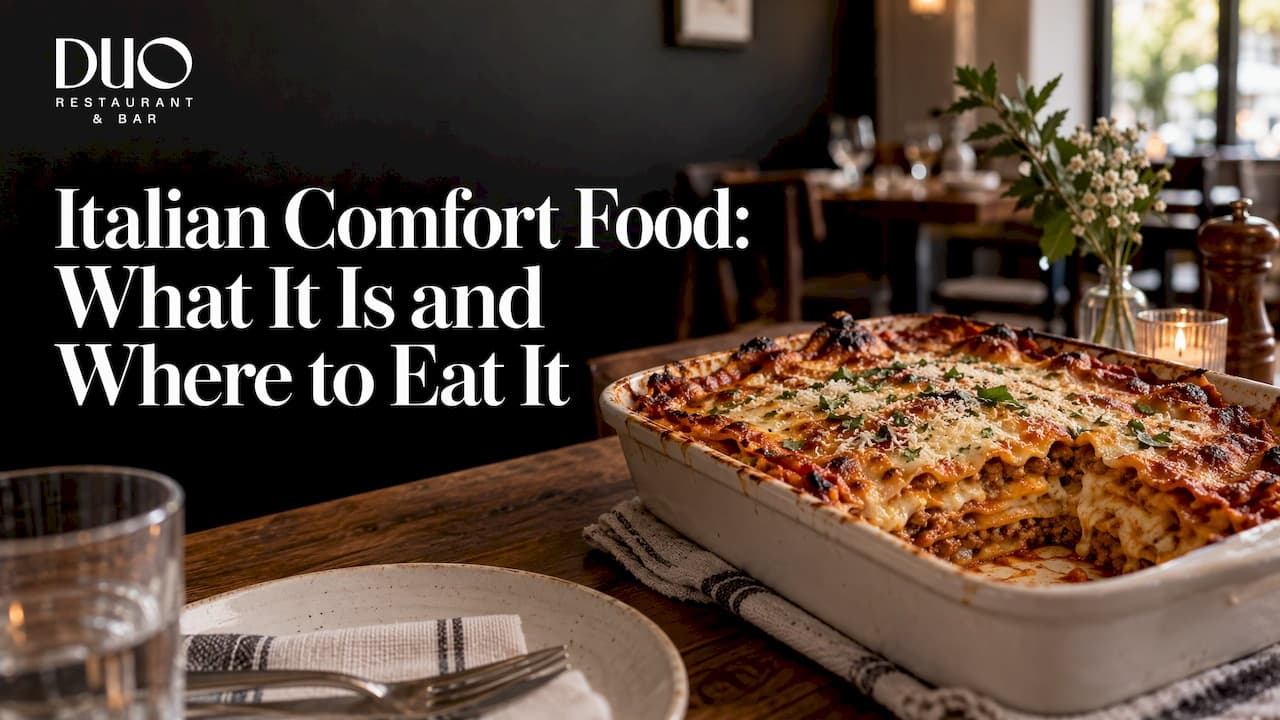
Italian comfort food is slow-cooked, generous home cooking: ragù simmered for hours, baked pasta with a bubbling top, soups thick enough to stand a spoon in, and polenta served warm. If you want it at a restaurant, look for a kitchen that makes its sauces and pastas by hand and cooks with the seasons. That is what we do at Duo Restaurant & Bar in Haddon Township, and this guide explains the dishes, the traditions behind them and how to order well.
TL;DR
- Italian comfort food comes from regional home kitchens: ragù, polenta, hearty soups, stews and baked pasta, many of them born from thrift.
- Italian-American versions tend to be bigger, cheesier and more tomato-forward than their regional Italian cousins, and both are worth loving.
- The best test of an Italian comfort food restaurant is a scratch kitchen: housemade pasta, sauces cooked in-house, seasonal ingredients.
- At Duo, we make nearly everything in-house, with seafood from Long Beach Island when available, plus a full bar and 18 craft beers on tap.
- South Jersey locals can drop in for happy hour, book a date night or plan a small group dinner.
Table of Contents
- What Italian comfort food really means
- The tradition of cucina povera
- Classic dishes to know
- Italian vs. Italian-American comfort food
- How seasons shape the menu
- Soft, warming Italian foods
- Comfort food you can make at home
- What to look for in an Italian comfort food restaurant
- Eating comfort food at Duo
- Come eat with us
- FAQ
- Sources
What Italian comfort food really means
Ask ten people for their favorite Italian comfort food and you will hear ten different dishes. One person wants a baked dish of layered pasta, another a bowl of beans and pasta on a cold night, another a plate of meatballs the way a grandmother made them. What they share is a feeling: warmth, patience, and food that was made to be shared.
The common thread in Italy is home cooking that rewards time. Braises, soups, stews, polenta and baked pastas are the backbone, and many of them started as clever ways to stretch what the kitchen already had. Italy's cuisine is important enough that it has been recognized as UNESCO Intangible Cultural Heritage, a reflection of how closely food is tied to national identity and family life.
So yes, Italian food is widely considered comfort food. The reason is less about calories than about how the food is made and how it is eaten: slowly, together, with plenty on the table.
The tradition of cucina povera
Many of the dishes we call comfort food grew out of cucina povera, literally the "poor kitchen." It is a frugal, no-waste tradition built on humble ingredients and leftovers, and as the BBC puts it in its piece on a classic pasta dish, it is poor in cost but not in flavor. Think of stale bread turned into ribollita, the Tuscan soup whose name means "reboiled," or pasta scraps cooked with potatoes in pasta e patate.

That history explains why these dishes feel so satisfying. Cooks learned to build deep flavor from very little: a slow-cooked soffritto of onion, carrot and celery, good olive oil, a rind of cheese in the pot, tomatoes cooked down until they turn sweet. Nothing fancy, only time and attention.
We love that idea, and it shapes how we run our kitchen. When you cook from scratch, you waste less, taste more and pay attention to every step.
Classic dishes to know
Here is a field guide to the dishes that come up most when people talk about Italian comfort food. Some are regional Italian, some are Italian-American, and a few are both.
Baked pasta: lasagna, baked ziti and stuffed shells
Layers, softness, sauce and cheese. Baked pasta is the dish most Americans picture first, and lasagna tops lists of traditional Italian comfort foods alongside meatballs in marinara. The pleasure is in the contrast: a crisp, golden edge on top, tender pasta underneath, and a sauce that has had time to settle into everything.
Ragù and slow-simmered sauces
A proper ragù is a patient dish. Meat is browned, simmered with aromatics and tomato, and left to cook until it is rich and clingy. Ragù is typically spooned over wide ribbons of fresh pasta or tucked into baked dishes. It is the clearest example of why handmade pasta matters: a fresh noodle holds a heavy sauce in a way a dried one often cannot.
Soups and beans
Pasta e fagioli (often called pasta fazool in Italian-American homes), ribollita and minestrone are the soups people crave on a cold evening. They are also a perfect lesson in cucina povera: beans, vegetables, a little pasta or bread, and a long, gentle simmer.
Polenta, risotto and braises
Northern Italian comfort leans on polenta, rice, butter and veal, while the south and Sicily use more tomato, olive oil and vegetables. Stews such as ossobuco sit at the heart of the northern tradition: tender meat, a glossy sauce, something soft underneath to catch it.
Meatballs, chicken parmigiana and other red-sauce favorites
These are the dishes that Italian-American families made their own. They are not a lesser version of Italian cooking. They are a distinct tradition with its own history, which is worth a closer look.
Italian vs. Italian-American comfort food
People often ask whether the Italian food they know from the Northeast is "real" Italian. It is real, just different. According to a history of Italian cuisine in America, regional Italian cooking emphasizes local ingredients and restraint, while Italian-American dishes reflect the immigrant experience and often feature larger portions, more cheese and meat, and more tomato sauce. The same source describes the "red sauce joint" as a tradition of its own, shaped by the ingredients available in the United States.
Here is a quick way to see the difference:
| Regional Italian | Italian-American | |
|---|---|---|
| Portions | Modest, often several courses | Generous, built to share |
| Sauce | Lighter, varies by region | Robust, tomato-forward |
| Cheese and meat | Used with restraint | Used more freely |
| Origins | Local ingredients, home kitchens | Immigrant adaptation of home recipes |
| Feeling | Seasonal, simple | Abundant, celebratory |
Neither one is better. A great Italian comfort food restaurant in New Jersey draws on both: the discipline of Italian cooking and the generosity of the Italian-American table.

How seasons shape the menu
Comfort food changes with the weather. In fall and winter we crave braises, baked pastas, soups and richer sauces. In spring and summer, comfort looks lighter: fresh tomatoes, zucchini, eggplant, garlic and good olive oil, with pasta that lets those ingredients speak.
Seasonal cooking also means paying attention to what is best right now. Along the Jersey Shore, that includes seafood, and at Duo we bring in seafood from Long Beach Island when it is available. That phrase matters: it means the dish depends on what the boats bring in, not on a fixed script. If a seafood special is on, it is there because it was fresh and worth cooking.
A few ways to order with the seasons in mind:
- Ask what is new on the menu and what the kitchen is excited about this week.
- In colder months, start with a soup or a small plate and follow it with a pasta.
- When seafood from Long Beach Island is available, consider it, especially if you want something lighter alongside a glass of wine.
- Share a few small plates for the table, then order your own pasta.
Soft, warming Italian foods
Some readers are looking for soft, easy-to-eat dishes: for a child, a grandparent, or just a tired night. Italian cooking is full of them. Polenta is creamy and mild. Risotto is soft and rich. Potato gnocchi are pillowy. Baked pastas, stuffed shells and manicotti are tender throughout, and soups with small pasta or beans are gentle and filling.
If you are dining with someone who prefers softer textures, tell your server. A scratch kitchen is flexible, and we are happy to help you find something comforting on the menu.
Comfort food you can make at home
If you want to try Italian comfort cooking in your own kitchen, begin with dishes that reward patience more than technique:
- A pot of beans and pasta. Soften onion, carrot and celery in olive oil, add beans and stock, and simmer. Finish with small pasta and a drizzle of oil.
- A simple tomato sauce. Cook garlic gently in oil, add good tomatoes, and let it simmer until sweet. Do not rush it.
- Baked pasta. Make a big batch of sauce, layer it with pasta and cheese, and bake until the top is golden.
- Pasta with vegetables. Eggplant, zucchini and fresh tomatoes are a classic combination, tied together with garlic and olive oil.
Home cooking is a joy. But some nights you want the aroma of a real kitchen, a full bar, and someone else doing the dishes. That is when we hope you will come see us.
What to look for in an Italian comfort food restaurant
Whether you are in Haddon Township, Haddonfield, Collingswood or beyond, a few signs tell you that a restaurant takes comfort food seriously:
- A scratch kitchen. Pasta, sauces and most dishes are made in-house, not assembled from boxes and bags.
- Seasonal thinking. The menu moves with the calendar, and there are specials when something great comes in.
- Honest, approachable dishes. Comfort food should not be fussy. The best plates are simple and executed with care.
- A real bar. A thoughtful wine list, a few cocktails and good beer make a big difference to the evening. Our wine pairing dinner guide shows how to match Italian dishes with wine.
- A warm room. You should be able to come in on a Tuesday in jeans and feel like you belong.
For more on how we think about the style of cooking we do, see our look at modern Italian dining.
Our perspective on Italian comfort food
We opened Duo in 2026 as a family-owned neighborhood spot, from the same team behind Il Villaggio in Cherry Hill. To us, comfort food is not a category on a menu. It is a way of cooking and a way of welcoming people.
That is why we run a true scratch kitchen. Handcrafted pasta, sauces made in-house, premium domestic meats and seafood from Long Beach Island when we can get it: these are the building blocks of comfort, and we believe you can taste the difference when each step is done by hand.
We also believe comfort belongs to everyone in the room. So we pair the kitchen with a full bar, signature cocktails, a curated wine list and 18 craft beers on tap, in a modern-rustic space that works for a quiet date night, a table of friends or a casual group gathering. Come hungry, leave inspired.
Jay
Eating comfort food at Duo
Here is how our neighbors tend to enjoy us.
Date night. A warm room, a shared small plate, a handmade pasta each and a glass of wine. It is easy and unhurried, and nobody needs to dress up.
Dinner with friends. Order a few plates for the table, add a round of craft beer from our 18 taps or a signature cocktail, and settle in. Friends coming from Haddonfield, Collingswood, Audubon, Oaklyn or Haddon Heights will find us easy to reach.
Happy hour. Our happy hour menu lists signature cocktails at $10-12, by-the-glass wine specials at $8 and plates and bites at $12. It is a relaxed way to try us for the first time.
A special occasion. If you want to go all in, our Chef's Menu is $98 per person.
Groups. For birthdays, showers or a team dinner, our private dining options suit small gatherings. Event Menu 1 is $36 per person, and Event Menu 2 is $51 per person. Our Elegant Cocktail Reception is also $51 per person.

Come eat with us
If this article made you hungry, we would love to feed you. Browse our full menu, pick a night, and book a table at Duo Restaurant & Bar in Haddon Township. Gift cards are available on our site for anyone who deserves a good dinner out.

Want a peek at the room and the plates first? Our photo gallery is a good place to start.
FAQ
What is Italian comfort food?
It is slow-cooked, regional home cooking such as ragù, polenta, soups, stews and baked pasta. Many dishes began as ways to use what was on hand, a tradition known as cucina povera. The result is food that is humble in cost and rich in flavor.
Is Italian food considered comfort food?
Yes. Italian cooking is built around family tables, patient techniques and generous plates. Regional Italian dishes favor restraint and local ingredients, while Italian-American dishes usually bring bigger portions, more cheese and more tomato sauce. Both can be deeply comforting.
What are examples of soft Italian foods?
Polenta, risotto, potato gnocchi, stuffed shells, manicotti and baked pasta are all tender and easy to eat. Soups with beans or small pasta are also gentle options. If you want help choosing at Duo, just ask your server.
What should I order at an Italian comfort food restaurant?
Start with something to share, then choose a pasta or a hearty main. In colder months, look for soups, baked dishes and braises. When it is on offer, seafood from Long Beach Island is a fresh seasonal choice at Duo.
Can I book a group at Duo?
Yes. We offer private dining for small gatherings, along with event menus and cocktail receptions. Details and menus are on our private events page.
Sources
- Italian cuisine, a UNESCO World Heritage asset (italia.it)
- Italy's frugal, 'no-waste' pasta dish (BBC Travel)
- 25 Traditional Italian Comfort Foods (Allrecipes)
- Italian Cuisine in America: History, Popular Dishes (Food Business USA)