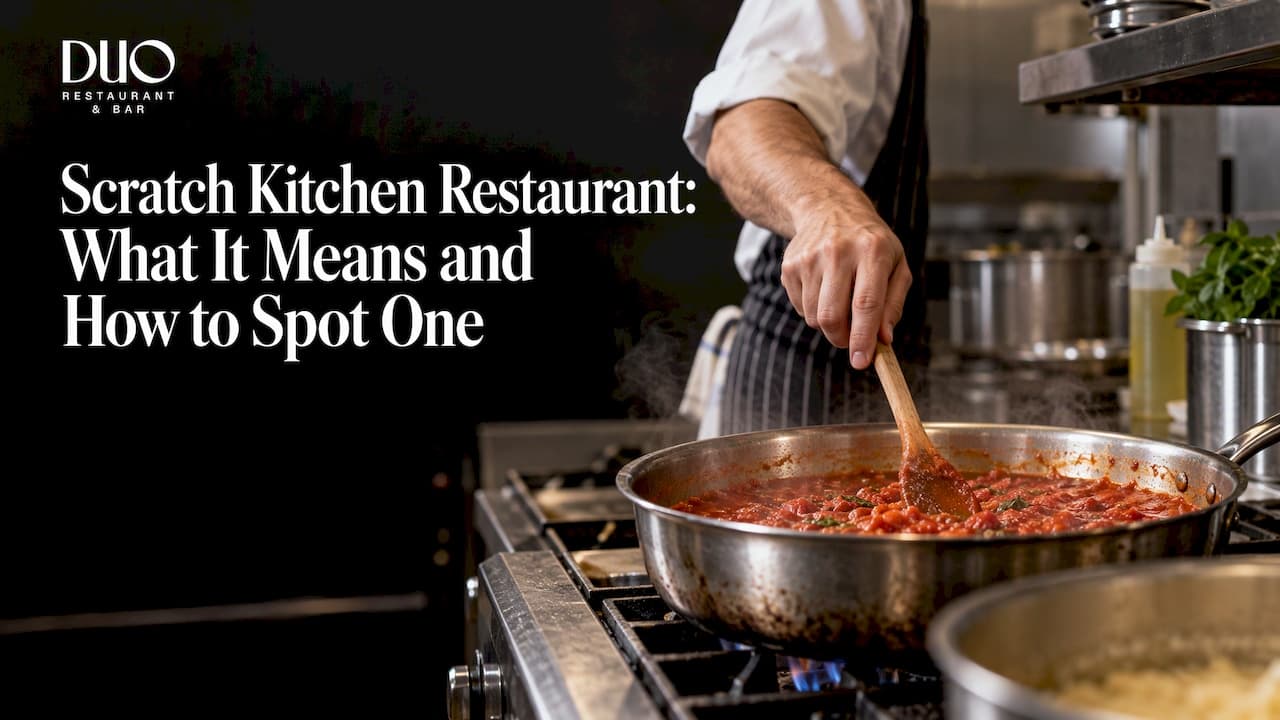
A scratch kitchen restaurant makes its food in-house from basic ingredients instead of relying mostly on ready-made products. The sauces, dough, dressings and pasta start as raw components in the building, not as a box delivered to the back door. At Duo Restaurant & Bar in Haddon Township, that is how we cook, and in this guide we explain what the term means, where it gets stretched, and what to look for on a menu when you want homemade Italian food.
TL;DR
- A scratch kitchen prepares most dishes and components in-house from basic ingredients, such as sauces, dough and cut produce.
- "Scratch" is a spectrum. Even well-run kitchens often describe themselves as scratch up to a certain percentage, so specifics on the menu matter more than the label.
- Scratch-made pasta is a different product from dried: fresh pasta cooks in minutes and has a tender, silky bite.
- Seasonal menus, short ingredient lists and house-made sauces are good signs. Our kitchen also uses seafood from Long Beach Island when available.
- Want to taste it? Reserve a table or look at our full menu.
Table of Contents
- What "scratch kitchen" actually means
- Scratch is a spectrum, not a switch
- What gets made in-house
- Scratch pasta: how it differs from dried and pre-made
- What scratch-made Italian food looks like
- Fresh and seasonal ingredients change the menu
- How to choose a scratch kitchen when you go out
- Our perspective
- Eating at Duo
- Near Haddon Township: who this suits
- FAQ
- Sources
What "scratch kitchen" actually means
The plain definition is simple. Food is made from fresh or basic ingredients rather than assembled from finished products. Dining Alliance describes a traditional scratch kitchen as one that prepares most dishes and components in-house. That could mean cutting potatoes for fries, preparing sauces and dressings, portioning proteins, chopping produce, making dough, or blending spices from individual seasonings.
That last list is worth reading twice, because it shows how many small jobs hide behind one word. A cook who whisks a vinaigrette, simmers a tomato sauce and rolls out dough before service is doing scratch work at three different points in the meal. A kitchen that opens a bag of frozen, pre-sauced pasta is doing none of it.
For a diner, the practical meaning is this: the dish on your table was built in that kitchen, by people you could, in principle, thank by name. Flavors tend to be cleaner, seasoning is adjustable, and the menu can change with what arrives fresh that week.
Scratch is a spectrum, not a switch
Honest chefs will tell you that 100 percent scratch is rare. Diane Ridge, writing in Club and Resort Chef, explains that being fully scratch, down to puff pastry made in house, is rare and often impractical at scale. Most kitchens call themselves scratch up to a certain percent: the à la carte dishes are traditionally scratch, while some high-volume items are not.
The same piece points out that so-called speed scratch products, meaning semi-prepped ingredients, save time for cooks at every level. Kitchens of every kind think hard about layout and timing too, and a good kitchen workflow and ticket time plan is part of how a busy line keeps cooking real food during a Friday rush.
So the useful question for a diner is not "is everything scratch?" It is "which parts of this menu does the kitchen make itself, and do they name them?" The dishes a restaurant is proudest of, its pastas, sauces and signature plates, are where scratch cooking should show most clearly.

What gets made in-house
The items that tell you the most are the ones that are easiest to buy ready-made. Here is what scratch kitchens commonly make themselves:
- Sauces and dressings. Tomato sauce, cream sauces, vinaigrettes and aiolis built from raw ingredients.
- Dough and breads. Pasta dough, pizza dough, focaccia and the croutons made from leftovers.
- Stocks and soups. Simmered from bones and vegetables, not reconstituted from a base.
- Cut produce. Vegetables prepped fresh each day instead of arriving pre-chopped.
- Proteins. Portioned and trimmed in-house, sometimes cured or ground there too.
Real examples help. The Restaurant Association describes a made-from-scratch burger concept where sauces are crafted on site, vegetables are cut fresh daily, and hand-cut fries are prepared every morning. A Northern California chef is reported to make nearly everything from scratch, including stocks, sauces, dressings and ketchup, though not the french fries. That small exception is typical. Every kitchen draws its own line, and the good ones know exactly where it is.
Scratch pasta: how it differs from dried and pre-made
Pasta is where the scratch label is easiest to taste. Epicurious explains that fresh pasta is usually made with eggs and flour, most often durum wheat or semolina, rolled out by hand or with a pasta maker, and cooks in under five minutes. Most dried pasta is flour and water, pressed or extruded into shapes, then dried.
Neither is wrong. They are different tools. Bon Appétit notes that fresh pasta has a tender, silky texture that suits filled pastas and noodles such as fettuccine, pappardelle and lasagna sheets, while dried pasta has a firmer bite that is ideal for everyday meals at home.
Why fresh pasta takes skill
Fresh pasta is a living product. A Serious Eats interview with a pasta maker notes that fresh pasta carries 30 to 40 percent moisture, so left on a counter it dries unevenly, and some of it cooks in two minutes while some takes ten. King Arthur Baking adds that fresh pasta typically needs only two to five minutes, compared with around ten for an average box of dried pasta.
What that means in a restaurant: the kitchen has to make pasta in rhythm with the dining room. It is rolled, cut, held properly and cooked to order. That is real labor, and it is the reason a plate of handcrafted pasta tastes the way it does.

What a pasta kitchen looks like on a busy night
Volume can surprise you. A Jersey City Italian restaurant profiled by New Jersey Monthly makes around 15 pounds of fresh pasta on a busy night and outgrew its first pasta machine within weeks of opening. When diners find pasta they love, they order it, and the kitchen has to keep up.
What scratch-made Italian food looks like
Italian cooking suits the scratch approach because its foundation is a short list of good ingredients. Food & Wine names garlic, olive oil, rich tomatoes, fresh cheeses, pasta and wine as iconic Italian ingredients, and notes how much the cooking varies across Italy's 20 regions and in American interpretations. Italian-American cooking has its own proud tradition: Lidia Bastianich's Italian-American Kitchen collects recipes for homemade ravioli, gnocchi, baked cannelloni and lasagna with meat sauce.
Sauce is the clearest test. Serious Eats calls tomato sauce the most important tomato-based preparation in the Italian kitchen, with endless versions, from quick-cooked and spicy to long-simmered. A kitchen that makes its sauce from scratch can choose which of those it wants to serve, and can tell you why.
If you enjoy the idea of Italian cooking that keeps its roots but feels current, our guide to modern Italian dining walks through what that style means and how to choose a place for it.
Fresh and seasonal ingredients change the menu
A scratch kitchen cooks with what is good right now. That is why seasonal menus and scratch cooking so often go together: when the cooks are building every sauce and starter themselves, they can shift a dish when the produce or the catch changes. A kitchen working from frozen, pre-portioned components has far less room to do that.
For us, that includes seafood from Long Beach Island when it is available. The words "when available" matter. They mean the menu follows the supply instead of promising the same thing every night, and it is part of why we ask guests to check our current menu before they come.

How to choose a scratch kitchen when you go out
You do not need to interrogate a server. A few quiet signals on the menu and in the room tell you most of what you need.
- Look for specifics. "Housemade pappardelle with slow-simmered ragu" says more than "homemade-style pasta." Named components suggest someone made them.
- Notice the pasta. Is it described as handcrafted or housemade, and are there several shapes and fillings? A varied pasta list is hard to fake.
- Read for seasonality. A menu that changes, or that mentions where an ingredient came from, points to cooks who buy fresh.
- Check the sauces and dressings. These are the items most often bought in. If they are described in detail, the kitchen is proud of them.
- Ask a simple question. "What do you make in-house?" A confident answer, with examples, is a good sign.
- Match the room to the occasion. Scratch cooking takes time. A relaxed pace suits a date night, a table of friends or a casual group dinner.
No kitchen is scratch in every corner, and that is fine. What you are looking for is a clear point of view about where the cooking happens.
Our perspective
We opened Duo in 2026 as a family-owned neighborhood spot, from the same team behind Il Villaggio in Cherry Hill, and we built the kitchen around one idea: cook the food ourselves.
To us, scratch cooking is not a slogan. It is the daily work of making pasta by hand, building sauces from fresh ingredients, and letting the season and the catch shape what goes on the plate. Our kitchen prepares nearly all of the menu in-house, and that is the standard we hold ourselves to.
We think this matters most in the simple dishes. When a plate of pasta is made properly, you do not need a long description. You taste the difference in the texture of the noodle and the freshness of the sauce.
It also changes the feel of the evening. A scratch kitchen is a little slower and a lot more personal, which is just right for a dinner with friends, a date night or a casual gathering. Come hungry, leave inspired.
Jay
Eating at Duo
Our menu centers on handcrafted pastas, approachable entrees, premium domestic meats, creative small plates and, when available, seafood from Long Beach Island. A full bar, a curated wine list and 18 craft beers on tap round it out, in a warm, modern-rustic room made for everyday moments.
If you want to go all in, our Chef's Menu is $98 per person. For a lighter, more casual visit, our happy hour menu lists signature cocktails at $10-12, wine specials at $8 a glass and plates and bites at $12.

Planning a get-together? Our private dining option suits small groups, and our event menus start with Event Menu 1 at $36 per person and Event Menu 2 at $51 per person. We also offer an Elegant Cocktail Reception at $51 per person. When you are ready, you can make a reservation. Gift cards are available too, for the friend who loves a good bowl of pasta.
Near Haddon Township: who this suits
We are a short drive for neighbors in Haddonfield, Collingswood, Haddon Heights, Audubon, Oaklyn and the surrounding towns. Couples often come for a date night, friends for a long dinner at the bar and families for a cozy table. People searching for homemade pasta nearby tend to find that a scratch kitchen is exactly the kind of place they had in mind: unfussy, welcoming and focused on the food.
FAQ
Does scratch kitchen mean everything is made in-house?
Not always. Most kitchens describe themselves as scratch up to a certain percentage, because making every last item in-house is rare and often impractical. The signs to look for are house-made sauces, dough and pasta, described in specific terms on the menu. At Duo, our kitchen is designed to prepare nearly all menu items in-house.
What is the difference between scratch-made pasta and regular pasta?
Scratch-made pasta is usually fresh, made from flour and often eggs, and cooks in under five minutes. Dried pasta is made from flour and water, extruded and dried so it keeps for a long time. Fresh pasta tends to be more tender, which is why it shines in filled pastas and ribbon noodles.
What is scratch-made Italian food?
It is Italian or Italian-American cooking where the sauces, pastas and other components are prepared in the restaurant from basic ingredients. Think tomato sauce simmered in-house, handcrafted pasta and dishes built on olive oil, garlic, cheese and fresh produce. Menus often change with the season.
Can I reserve a table for a group at Duo?
Yes. You can book through our reservations page, and for small private gatherings you can look at our private dining page and event menus. Tell us the size of your party and the occasion, and we will help you plan.
Sources
- What Is a Scratch Kitchen? Benefits, Costs & Tips (Dining Alliance)
- What Does It Mean to Be a "Scratch" Kitchen? (Club and Resort Chef)
- Made-From-Scratch Playbook (Restaurant Association)
- Inside The Porch Kitchen (Sonoma Magazine)
- How to Buy the Right Pasta for Any Recipe (Epicurious)
- Homemade Pasta Dough Recipe (Bon Appétit)
- Obsessed: Resurrecting the Art of Fresh Pasta (Serious Eats)
- How to cook fresh pasta (King Arthur Baking)
- House-Made Pastas in Jersey City (New Jersey Monthly)
- 36 Irresistible Italian Main Dishes (Food & Wine)
- Lidia's Italian-American Kitchen (Penguin Random House)
- How to Cook Italian Food Like an Italian (Serious Eats)
- Kitchen Workflow Optimization (Superior Kitchen Equipment)