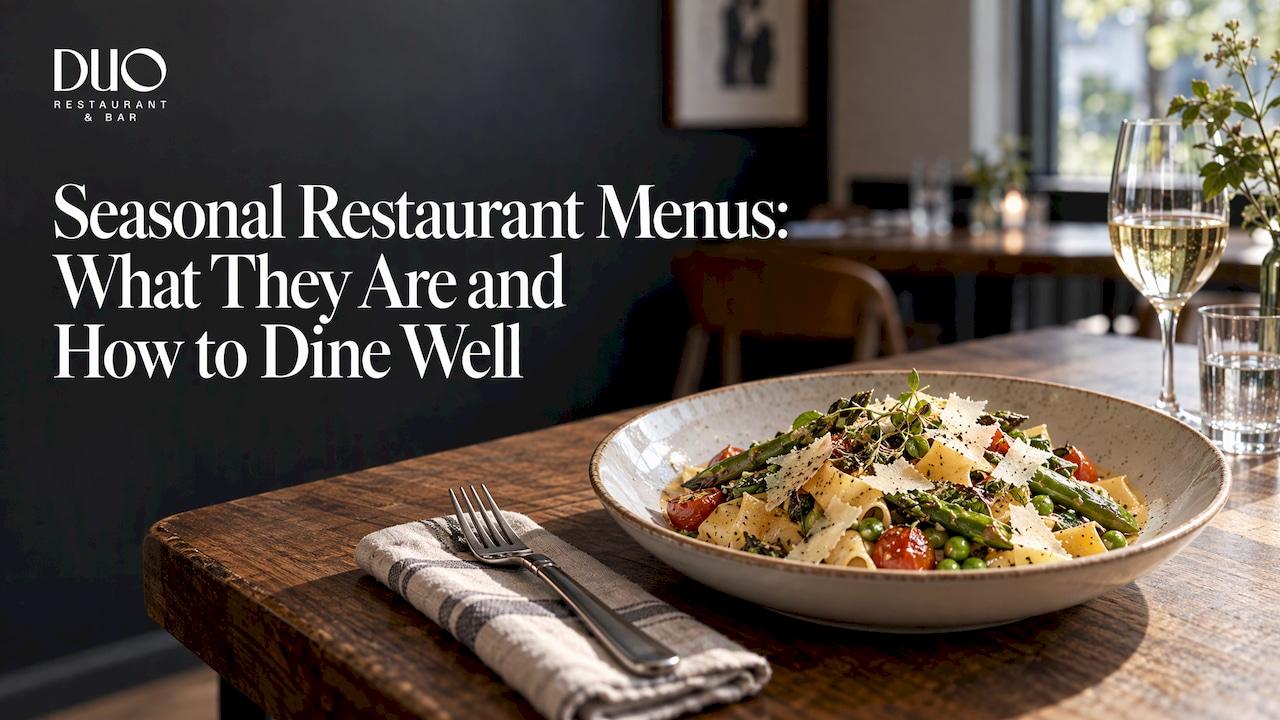
A seasonal restaurant menu is built around ingredients at their peak right now, and it changes as the weather and the harvest change. Some kitchens rework the whole menu each season. Many keep their best sellers and rotate a handful of dishes. For you as a diner, it means fresher flavor, a few surprises, and the occasional dish that is gone by the time you come back. Below we explain how seasonal menus work, how to read one, and how we think about it at Duo in Haddon Township.
TL;DR
- A seasonal menu features in-season produce, seafood and other ingredients, and it changes a few times a year, often with weekly or daily specials in between.
- "Seasonal" only means something relative to where you are and when you visit, so a South Jersey kitchen's summer looks different from a restaurant's in another region.
- You can ask your server which dishes are in season, where the ingredients come from, and how often the menu changes.
- At Duo, we cook from scratch and use seafood from Long Beach Island when it is available, so ask what is on the board the night you visit.
- You can see our full menu before you book a table.
Table of Contents
- What a seasonal restaurant menu actually is
- How kitchens decide what goes on the menu
- How a seasonal menu changes through the year
- What to expect when you dine at a seasonal restaurant
- How to read a seasonal menu like a regular
- Our perspective on cooking with the seasons
- What this looks like at Duo
- Plan your visit to Duo
- Why seasonal cooking suits a neighborhood restaurant
- Frequently asked questions
- Sources
What a seasonal restaurant menu actually is
At its simplest, a seasonal menu is a limited-time offering that uses in-season items, such as fruits and vegetables at the height of freshness. Culinary textbooks have a name for it too: a "market menu" is based on the products available in the market, and it is also called a seasonal menu.
In practice, a seasonal menu can take a few shapes:
- A full seasonal menu. The whole list changes with the season: spring, summer, fall, winter.
- A rotating section. A steady core of favorites stays put, and one part of the menu turns over. Menubly describes a seasonal menu as typically changing three to four times a year, either as a standalone format or as a rotating section inside a static core menu.
- Specials. Weekly or daily dishes built on very short-season produce or whatever the kitchen found that morning.
None of these is better than the others. A neighborhood restaurant that wants you to come back every week usually benefits from a reliable core plus something new to try. A tasting-style restaurant may rewrite everything.
How kitchens decide what goes on the menu
Seasonal menus do not start with a list of dishes. They start with what is available. One executive chef quoted in Hotel Management begins by deciding which proteins he wants to use, then looks at which vegetable seasons are approaching and builds dishes around them. Another says his team also weighs guest trends and the restaurant's location.
That order of thinking matters to you as a diner. When the produce drives the plate, the dish tends to taste like the moment it was made in.
Why peak ingredients matter
There are a few reasons chefs plan this way:
- Flavor. Seasonal ingredients are often better in flavor, texture and appearance, and frequently at a better price.
- Less waste. Escoffier's discussion notes that seasonal offerings are less likely to waste ingredients.
- Interest. A seasonal menu can keep guests curious through limited-time dishes and give chefs room to try new ideas.
- Guest appeal. In one survey, 49% of consumers said a seasonal menu sounds more appetizing, and to them seasonal means fresh and full of flavor.
Where South Jersey kitchens source
For New Jersey kitchens, "local" is only one part of the picture. A regional produce supplier explains that a distributor may source from Northeast local, other domestic regions, imported, and storage or greenhouse crops, whichever combination gives the best quality and value at the time of the order. That is a realistic description of how a working kitchen handles January tomatoes versus August ones.
The point is that "seasonal" is a way of choosing, not a promise that every item on the plate grew within ten miles. Produce also varies with growing conditions and geography, so no two harvests are exactly alike.
How a seasonal menu changes through the year
The calendar in South Jersey gives a kitchen plenty to work with. Here is how the seasons tend to feel on a plate, using the same kind of examples seasonal-menu guides use. Toast notes that a summer menu may feature watermelon and corn on the cob, while a fall menu leans toward soups, brussels sprouts and sweet potatoes.
| Season | What tends to show up | How it eats |
|---|---|---|
| Spring | Tender greens, peas, asparagus, herbs | Lighter sauces, bright finishes |
| Summer | Tomatoes, corn, zucchini, basil, fresh seafood | Simple preparations, cold salads, grilled dishes |
| Fall | Squash, brussels sprouts, sweet potatoes, mushrooms | Soups, roasted plates, richer sauces |
| Winter | Storage crops, root vegetables, braises | Slow-cooked, hearty comfort dishes |
This table is a general pattern, not a description of any one restaurant's menu, and peak timing varies by region and by year.
How often menus turn over
One US guide suggests that quarterly changes suit fine dining, with other restaurant types changing less often. Many kitchens keep a stable core and rotate a smaller seasonal section, adding weekly or daily specials on top.
Some chefs also ease the change in rather than flipping a switch. Philadelphia chefs interviewed by Eater describe introducing new seasonal dishes one or two at a time instead of replacing everything overnight. As a guest, that explains why a dish you loved last month may still be there while the dish next to it is new.
The role of specials
Specials are where the freshest, shortest-season ingredients usually appear. Restaurants use them to showcase hyper-seasonal ingredients that are available only briefly and cannot sit on a permanent menu. Kitchens also use them as a lower-risk way to test dishes for the next seasonal menu. If you like to try something new, specials are the first place to look.

What to expect when you dine at a seasonal restaurant
Here is what changes for you at the table:
- The menu may not match what you saw last time. That is the point, not a mistake.
- Some dishes are limited. When a dish depends on a short harvest or a particular catch, it can sell out or leave the menu.
- The best thing may not be printed. Ask about the specials.
- Prices can shift with availability. Seasonal sourcing is one lever kitchens use to stabilize pricing.
- Drinks can follow the season too. Seasonal beverage programs are a common companion to the food menu.
Many diners also care about where the food comes from. In research cited by Toast, 90% of consumers said sustainability matters to them in general. A seasonal menu is one of the more visible ways a kitchen responds to that.
How to read a seasonal menu like a regular
"Seasonal" is a word a menu can use loosely, so it helps to ask. FoodPrint's guide to dining out sustainably suggests keeping location and timing in mind: check whether an item is actually in season where and when you are eating, look for information about farms or origins on the menu, and ask your server where ingredients come from.
A few friendly questions go a long way:
- Which dishes are in season right now?
- Are there seasonal specials tonight?
- Where does the seafood come from today?
- How often does the menu change?
Good servers love these questions. They are the shortest path to the best dish in the room.
Our perspective on cooking with the seasons
We opened Duo in 2026 as a family-owned neighborhood spot, and the way we cook comes from the same team behind Il Villaggio in Cherry Hill. We run a true scratch kitchen, which means we prepare nearly everything in-house, from our handcrafted pastas to our sauces.
To us, seasonal cooking is not a trend. It is how a scratch kitchen works best. When you make things by hand, you notice quickly when an ingredient is at its peak, and you build the plate around it. That is why we use fresh, seasonal ingredients, including seafood from Long Beach Island when it is available.
We also think seasonal food should feel easy. You should not need a vocabulary lesson to order. Our approach is approachable entrees, creative small plates, premium domestic meats and housemade pasta, served in a modern-rustic room where a family dinner, a date night and a casual group gathering all feel at home.
So ask us what is good tonight. We would love to tell you. Come hungry, leave inspired.
Jay
What this looks like at Duo
We are an Italian-inspired neighborhood restaurant, so the seasons show up in the details: fresh ingredients, handcrafted pasta, and seafood from Long Beach Island when it is available. Because availability can change, the best way to see what we are cooking is to browse our current menu and ask your server about anything that is not listed.
The drinks side follows the same spirit. We pour signature cocktails, a curated wine list and 18 craft beers on tap. Our happy hour menu lists signature cocktails at $10-12, by-the-glass wine specials at $8 per glass and plates and bites at $12, which makes it an easy way to try a few things in one relaxed sitting.
If you want to learn more about the style of cooking behind the menu, our guide to modern Italian dining walks through what it means and how to choose a spot.

Dining in a group or planning an occasion
Seasonal food works well for gatherings because it gives everyone something to talk about. We host small private gatherings and offer set menus per person:
| Option | Price |
|---|---|
| Event Menu 1 | $36 per person |
| Event Menu 2 | $51 per person |
| Elegant Cocktail Reception | $51 per person |
| Chef's Menu | $98 per person |
We also offer private dining for groups near Haddonfield and across the neighborhood. Check the event pages for what each menu includes.
Plan your visit to Duo
Whether you are coming from Haddon Township, Haddonfield, Collingswood, Haddon Heights, Audubon or Oaklyn, we would love to host you for dinner with friends, a date night or a casual group meal. Look over the menu, pick a night, and reserve your table.

Looking for a gift for someone who loves a good dinner out? Our gift cards are available to purchase online.
Why seasonal cooking suits a neighborhood restaurant
Seasonal menus are often discussed as a business tactic. Menubly reports industry research suggesting seasonal menus can lift order profits by up to 26% and seasonal beverage programs can raise the average check by 25%. Those figures speak to the restaurant side of the story.
For a neighborhood place, the real value is simpler. Regulars get a reason to return, because the table in front of them is a little different each time. Cooks get to work with ingredients at their best. And the whole room feels connected to the time of year, which is exactly what you want from a local spot on an ordinary Tuesday.

Frequently asked questions
What is a seasonal menu?
A seasonal menu is a limited-time menu built on in-season ingredients, such as produce at its peak. It may replace the whole menu with each season or rotate only a section while a core of favorites stays. Weekly or daily specials often fill the gaps.
How often do restaurants change their seasonal menus?
Many restaurants change a seasonal menu three to four times a year, once per season, while others swap only a few dishes at a time. Some add specials weekly or daily. If you want to know a particular restaurant's rhythm, ask your server how often the menu is updated.
How do I know if a dish is really in season?
Think about where you are and the time of year, then ask your server whether the dish is in season and where the ingredients come from. Menus that name farms or origins make this easier. A good kitchen will be glad to explain.
Does Duo use seasonal ingredients?
Yes. We cook from scratch with fresh, seasonal ingredients, including seafood from Long Beach Island when it is available. Our menu page shows what we are serving, and your server can tell you what is especially good that night.
Sources
- How You Can Build a Seasonal Menu for Your Restaurant
- 7.1: The Menu, Workforce LibreTexts
- Types of Menu to Use in Your Restaurants & Hotels, Menubly
- How to Build Profitable Seasonal Menus, Hotel Management
- Advantages of Seasonal Menu Purchases, Sysco Foodie
- 4 benefits of a seasonal menu and how to design one, Yelp
- Seasonal menus: why they're worth the effort, me&u
- Seasonal Produce Guide for NYC & NJ Restaurant Kitchens
- How restaurants can combat ingredient inconsistencies, Supply Chain Dive
- How to Improve Your Sales With A Seasonal Menu, Toast
- When to Change Your Restaurant Menu
- Seasonal Menu Planning: 8-Week Timeline, Ideas and Costing
- How Philly Chefs Change Their Menus With the Seasons, Eater Philly
- Is the Daily Special Really Special?, Bon Appétit
- Sustainable Dining and Sustainable Restaurants, FoodPrint