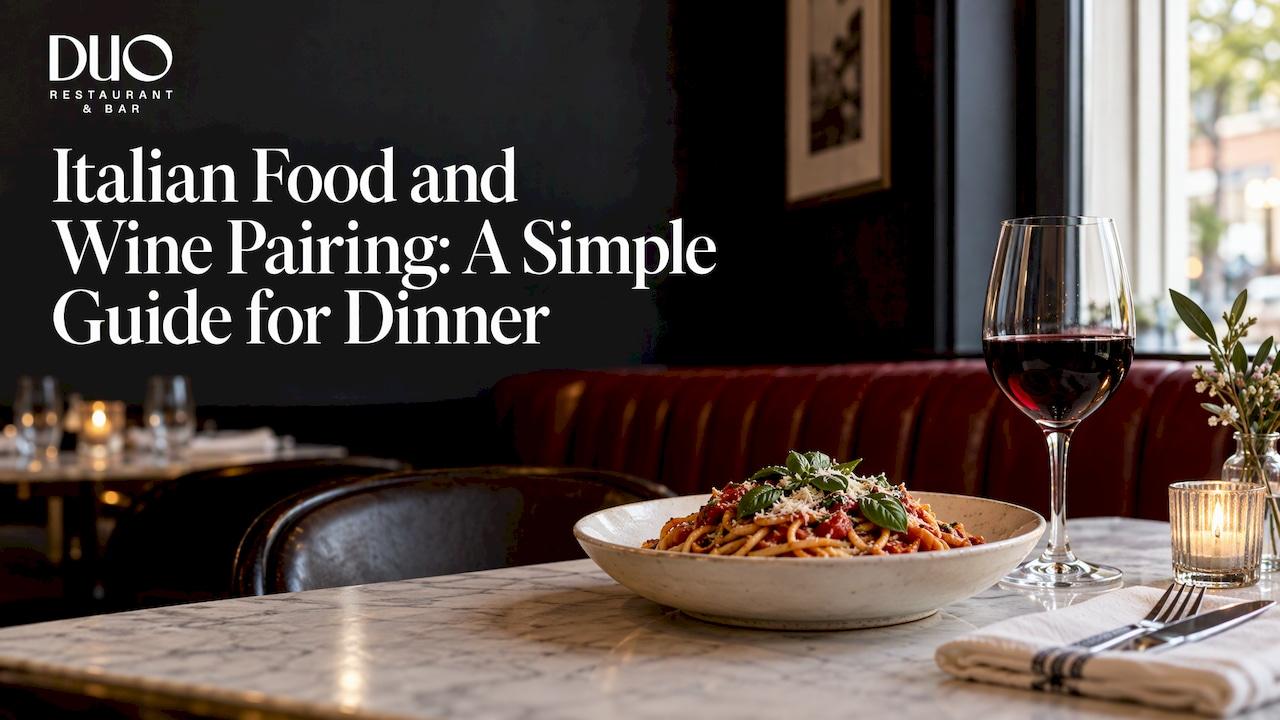
The easiest way to pair wine with Italian food is to match the wine to the sauce, not to the pasta. A bright, medium-bodied red like Chianti suits tomato. A crisp white like Vermentino or Pinot Grigio suits seafood. Dry sparkling wine suits anything fried. Barbera suits a slow-cooked ragù. At Duo in Haddon Township, we build our scratch-made Italian menu around exactly this kind of table, with a curated wine list beside it, so you can order the glass and the plate together.
TL;DR
- Pair with the most prominent element of the dish, usually the sauce, rather than the pasta shape or the meat or fish category.
- Tomato dishes and pizza want a red with good acidity and soft tannins: Chianti, Sangiovese, Barbera.
- Seafood and light starters want crisp whites: Vermentino, Pinot Grigio, Verdicchio, or sparkling wine.
- Rich, meaty dishes can handle bigger wines, but still need acidity to cut through the fat.
- Not sure? A dry Italian rosé or a light, fruity red is the safest bet across a shared table.
Table of Contents
- The one rule that does most of the work
- Tomato sauce, pizza and red-sauce classics
- Cream, cheese and butter: freshness cuts the richness
- Seafood and lighter starters
- Rich meat dishes and heavier entrees
- A quick pairing chart
- "What grows together, goes together"
- Beyond wine: beer and cocktails with Italian food
- Our point of view
- Ordering at the table
- Pair it with dinner at Duo
- FAQ
- Sources
The one rule that does most of the work
Wine Spectator's broad rule for pasta is to match the wine to the most prominent element in the dish. That is why "red with meat, white with fish" breaks down so quickly at an Italian table. A spaghetti with fresh tomato and basil, a creamy fettuccine and a bowl of clams are all pasta, yet each wants a different glass.
Think of a sauce as having a few dominant traits:
- Acidity (tomato, lemon, white wine reductions)
- Fat (olive oil, butter, cream, cheese, egg yolk)
- Weight (a light seafood sauce versus a long-simmered meat ragù)
- Heat (chili in an arrabbiata)
The wine's job is to balance whichever trait leads. Acid wants acid, fat wants freshness or tannin, and delicate flavors want a delicate wine.
There is also a reason the glass changes how the food tastes. According to the wine educators at WSET, food high in salt, acidity, sugar, fat or chili changes how a wine tastes, often making it seem softer, sweeter and fruitier. A wine that feels sharp on its own can feel just right next to a salty, savory plate. So you are not choosing a wine in isolation. You are choosing how it will taste with a particular forkful.
Tomato sauce, pizza and red-sauce classics
This is where most Italian dinners start, and where one mistake is most common: reaching for a big, tannic, oaky red because it feels like the serious choice.
Food & Wine explains that cooking softens a tomato's acidity and heightens its sweetness, but the sauce stays acidic enough that the writer rules out tannic, full-bodied, oaky reds, since they clash with it. The better move is acid matching acid.
For a simple spaghetti with fresh tomato and basil, Wine Spectator suggests a fruity, bright red such as Chianti, a medium-bodied Sangiovese, because it balances the tomato's sweetness and acidity without overwhelming the basil. Decanter's guidance for pasta al pomodoro leans lighter still, fruit-forward reds with moderate acidity and soft tannins, and names an entry-level Pinot Nero or Schiava from Alto Adige. Decanter also notes that fresh tomatoes are more acidic, while ready-made sauce tends to be sweeter, so the sauce's character matters as much as the word "tomato."
If you want to stay in Italy, Food & Wine lists several Italian options for tomato sauce: fruity, low-tannin Barbera and the slightly less acidic Dolcetto from Piedmont, earthy and spicy Chianti Classico from Tuscany, and red wines from Mount Etna in Sicily.
Pizza
Pizza follows the same logic, with dough and cheese adding a savory, chewy element. Decanter's pizza guide says a wood-fired Napoletana with tomato and mozzarella wants good acidity and bright fruit, pointing to Barbera d'Asti, a lighter Sangiovese or Frappato. Its list of all-rounders also includes Nero d'Avola, Fiano and Prosecco. For a white pizza with no tomato, Travel + Leisure's sommelier sources suggest whites with sustained acidity or sparkling wine.
A quick note on spice
A chili-heavy arrabbiata is a different case. Heat makes alcohol feel hotter and tannin feel harsher, so lean toward a fruit-led, lower-alcohol red or a dry rosé. Fridays with friends, a table of shared plates and a bit of heat is exactly when a chilled, dry rosé earns its place.

Cream, cheese and butter: freshness cuts the richness
When the sauce is built on fat rather than acid, the pairing flips. A carbonara, a cacio e pepe or a baked pasta with béchamel does not need tomato-style acidity so much as freshness and a clean finish. A dry white with some body, or a light red without aggressive tannin, keeps the richness from feeling heavy.
Jancis Robinson's food-first list is a handy cross-check. For pasta such as spaghetti it lists Chianti, Valpolicella, Dolcetto, Sangiovese and Barbera. For pesto it lists Pinot Grigio, and for risotto, Pinot Grigio, Chianti and Barbera. Those lists make a useful point: a handful of versatile Italian grapes covers an enormous share of the menu.
Seafood and lighter starters
Seafood is where the red-with-everything habit does the most damage. Delicate shellfish and white fish are easily bullied by tannin, so the safest direction is a dry, crisp, mineral white.
Bon Appétit's shrimp scampi recipe pairs it with a crisp, dry Italian white such as Vermentino or Pinot Grigio. The same family of whites, plus Verdicchio, Soave and Gavi, works across clams, calamari, grilled fish and lemon-butter sauces. A seafood dish with a substantial tomato base is the exception: there, a dry rosé or a light red often fits better than a white.
We are lucky to cook with seafood from Long Beach Island when it is available, and a simple preparation lets the fish speak. That is when a clean, crisp white earns its keep, because it frames the sweetness of the seafood rather than covering it.

Fried starters
Fried food, such as arancini, fritto misto or fried zucchini, wants bubbles. A dry sparkling wine refreshes the palate between bites and cuts through the oil. Prosecco is the familiar choice, and it comes with real rules behind it: the Consorzio Tutela Prosecco DOC explains that Prosecco is based on the Glera grape, with up to 15% of other permitted varieties, and that only wines meeting the production specifications may carry the name.
Rich meat dishes and heavier entrees
Braised meats, sausage and ragù are the dishes where a bigger red feels natural, and it can be. Even so, acidity matters. Decanter recommends Barbera with a meaty ragù served over egg pasta, because its natural acidity cuts through the richness of the sauce.
For the real heavyweights, Barolo is the classic. The Langhe Vini consortium describes it as made from 100% Nebbiolo in the Langhe hills of Piedmont, aged at least 38 months, with at least 18 of them in oak. That structure is why it stands up to prime cuts, truffles and aged cheese. It is a wine for the long, slow dinner, not a quick Tuesday pasta.

A useful middle path is a mid-weight Sangiovese or Montepulciano d'Abruzzo: enough body for sausage or a braise, enough acidity to keep the plate lively.
A quick pairing chart
| If your plate is... | Reach for... | Why it works |
|---|---|---|
| Spaghetti with tomato and basil | Chianti, Sangiovese, Barbera | Acidity matches the tomato; soft tannins stay out of the way |
| Margherita or red-sauce pizza | Barbera, light Sangiovese, dry Italian rosé | Bright fruit and acidity handle tomato and cheese |
| Creamy or cheesy pasta | Pinot Grigio, or a light red without heavy tannin | Freshness balances the fat |
| Shrimp scampi, clams, light fish | Vermentino, Pinot Grigio, Verdicchio | Crisp and mineral, no tannin to overpower |
| Fried starters | Prosecco or another dry sparkling wine | Bubbles and acidity cut through oil |
| Meat ragù, braises | Barbera, Sangiovese, Montepulciano d'Abruzzo | Acidity slices through richness; body matches weight |
| Aged cheese, prime cuts, truffle | Barolo or Barbaresco | Firm tannin and structure meet fat and depth |
Treat the chart as a starting point, not a verdict. If two people at the table order a tomato pasta and a seafood dish, a bottle of dry rosé or a glass each is easier than agonizing.
"What grows together, goes together"
The regional shortcut is worth knowing. An FSR Magazine interview with a pairing expert offers a restaurant-style heuristic: look at where the dish is from. Dishes and wines from the same region evolved side by side, which is why Piedmont's Barbera loves a local ragù and why Tuscan Sangiovese loves tomato and olive oil.
That said, you are not required to stay in Italy. Food & Wine points out that in the United States, Italian food can be paired with wines from anywhere. A light, high-acid American red or a crisp white from elsewhere can do the job. What matters is the balance of acidity, weight and tannin, not the passport.
If you want a second general reference to keep on hand, this wine pairing guide covers the basics for restaurant diners.
Beyond wine: beer and cocktails with Italian food
Wine is the classic partner, but it is not the only one. Bubbly, bitter and citrusy drinks all play well with Italian flavors. If your table is split between wine and beer drinkers, our guides to beer pairing dinners and to pairing food with cocktails apply the same sauce-first thinking. And if you are planning a whole evening around the glass, our guide to planning a wine pairing dinner walks through course-by-course choices.
Our point of view
We cook from scratch, so we think about wine the way we think about a sauce: it should make the plate taste more like itself.
Our kitchen makes pastas by hand and leans on fresh, seasonal ingredients, including seafood from Long Beach Island when we can get it. When food is made that way, the flavors are clear and a simple wine can shine beside them. You do not need a bottle with a famous name. You need a glass with the right acidity and the right weight for what is on your fork.
That is why our wine list is curated rather than long for its own sake, and why we pour wine specials by the glass. A glass lets two people at the same table enjoy two different dishes without compromise, and it lets a table of friends try a crisp white with the starters and a Sangiovese with the pasta.
Our advice to every guest is the same one we would give a friend: tell us what you are eating, and tell us whether you like your wine bright and light or round and rich. Come hungry, leave inspired.
Jay
Ordering at the table
Here is a simple routine that works at any Italian restaurant, and is easy to follow at ours.
- Pick your dish first. Decide on the pasta, entree or pizza before you open the wine list.
- Name the leading element. Is it tomato, cream, seafood, or a rich meat sauce? That sets your style of wine.
- Choose by the glass if you are ordering differently. A bright red for the tomato dish and a crisp white for the seafood beats a compromise bottle.
- Start with bubbles if you are sharing small plates. Dry sparkling wine is forgiving across fried, salty and cured bites.
- Mind the temperature. Whites and sparkling wines are best well chilled, reds slightly cool rather than warm.
Our small plates guide shows how to build a shared table, and our piece on Italian meat dishes helps if you are leaning toward a heavier entree and a bolder red.
Pair it with dinner at Duo
We are a family-owned neighborhood restaurant in Haddon Township, from the same team behind Il Villaggio in Cherry Hill. Our menu centers on handcrafted pastas, fresh seafood and premium domestic meats, with a full bar, a curated wine list and 18 craft beers on tap. Our happy hour menu lists by-the-glass wine specials at $8 a glass, signature cocktails at $10-12 and plates and bites at $12, an easy way to try a pairing without committing to a bottle.

For a couple on date night, friends gathering from Haddonfield or Collingswood, or a family looking for a cozy table, you can look over our full menu and reserve through our website. If you are planning a small gathering, our private dining options let you build the evening around the food and wine you want.
FAQ
What wine pairs with Italian pasta?
Match the sauce. Tomato sauces like a bright, medium-bodied red such as Chianti or Barbera. Seafood pastas like crisp whites such as Vermentino. Creamy sauces like a fresh white or light red, and meat ragù suits Barbera or a mid-weight Sangiovese.
What is the safest wine to order if I am unsure?
A dry Italian rosé or a light, fruity, low-tannin red is the most forgiving across a mixed table. Light to mid-weight wines with good fruit and acidity tend to work best with most pasta, according to Decanter, because bold, oaky wines tend to overpower sauces.
Do I have to drink Italian wine with Italian food?
No. Italian wines often fit because they grew up beside the cuisine, but what counts is acidity, weight and tannin. Wines from other regions can match well when those qualities suit the dish.
Should I choose red or white with Italian food?
Choose by the sauce rather than by color. Tomato and meat usually lead to red, while seafood, fried starters and light dishes usually lead to white or sparkling. A dish with a lot of tomato and seafood together can sit comfortably with a dry rosé.
Sources
- Which Wines Pair Best with Pasta? | Wine Spectator
- The Best Wine With Pizza, Pasta, and Other Tomato Sauce | Food & Wine
- Italian pasta and wine: The best pairings | Decanter
- Best wine with pizza | Decanter
- Classic Italian dishes: wines to drink with them | Decanter
- The Best Wines to Pair With Pizza | Travel + Leisure
- Food matching: food first | Jancis Robinson
- Shrimp Scampi | Bon Appétit
- Prosecco | Consorzio Tutela Prosecco DOC
- Barolo DOCG | Langhe Vini
- Four rules to masterful food and wine pairing | WSET
- How to Pair Wines with Italian Food | FSR Magazine
- Does Italian Food Really Pair Best with Italian Wine? | Food & Wine
- Wine Pairing Guide | Pekin the Chef