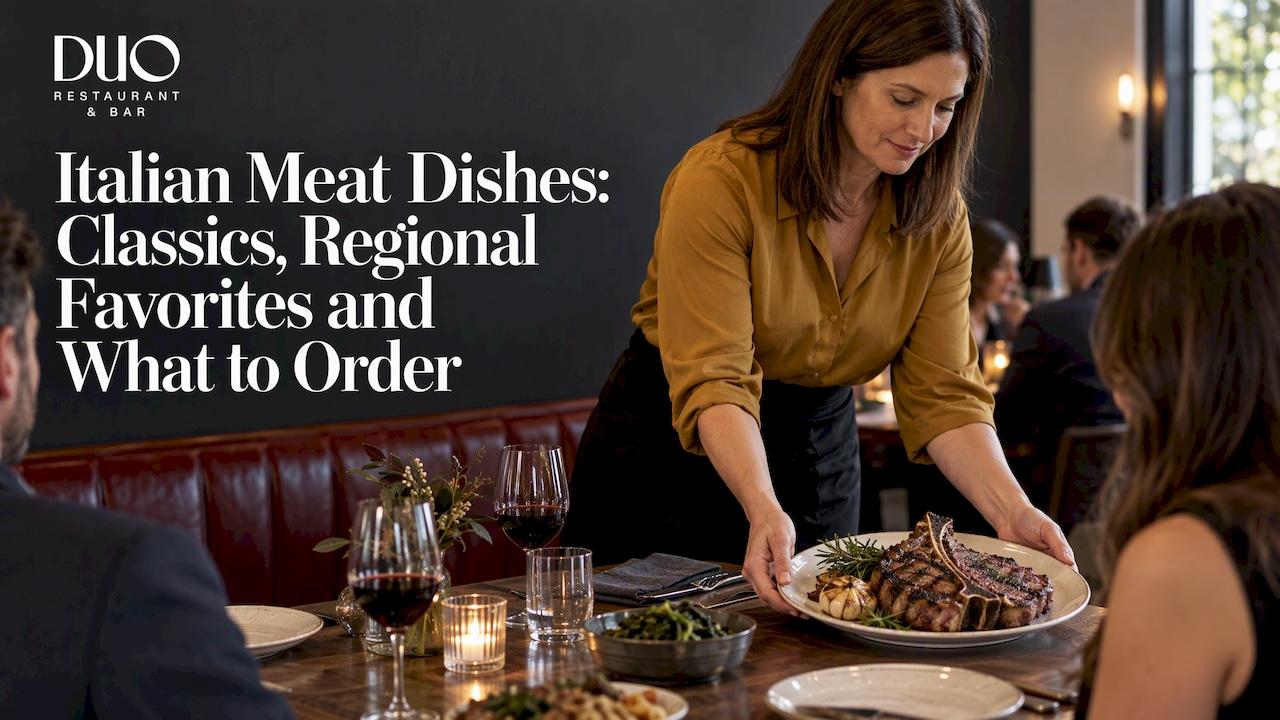
The best Italian meat dishes are the ones cooked slowly, from scratch, with a good cut and very few shortcuts: braised beef and veal, a rolled and stuffed braciole, a charcoal-grilled steak, a pot of Sunday sauce with pork and beef. Some come straight from Italy's regions, others grew up in Italian-American kitchens, and all of them reward a kitchen that has the patience to do them properly. Here is how to tell them apart, what each one tastes like, and how to choose for a family table, a date night or a bigger gathering. At Duo Restaurant & Bar in Haddon Township, scratch cooking is how we work, and the menu is built around housemade pastas and premium domestic meats.
TL;DR
- Italian meat dishes fall into three families: slow braises (ossobuco, brasato, braciole), quick-cooked cuts (bistecca, cotoletta, saltimbocca) and roasts or sauce-simmered meats (porchetta, ragù).
- Italian-American classics such as chicken parm, meatballs and baked ziti are a tradition of their own, built on abundance and big flavor.
- Braises and ragù suit a family table; a bone-in veal shank or a thick steak suits a special night.
- Scratch cooking matters most in these dishes, because the sauce, the stuffing and the slow braise are where the flavor comes from.
- Duo's full menu is online, and our chef's menu is $98 per person.
Table of Contents
- Two traditions, one table
- The braises: where Italian meat cooking shines
- Veal, from cutlets to cold slices
- Steak and roasts: the quick and the celebratory
- Ragù and Sunday sauce: meat and pasta together
- The Italian-American favorites
- Premium meat entrees: what sets them apart
- How to choose the right dish for the night
- Regional flavors worth knowing
- Our perspective
- Plan your Italian meat dinner at Duo
- FAQ
- Sources
Two traditions, one table
When people search for Italian meat dishes, they usually mean one of two things. The first is the regional cooking of Italy: veal shanks in Milan, beef braised in wine in Piedmont, steak over coals in Tuscany. The second is Italian-American cooking, the red-sauce tradition that most of us grew up with in New Jersey.
Both are worth ordering. Food & Wine describes Italian-American food as marked by abundance, with lots of meat, even more cheese and big flavors, and its collection runs from lasagna and spaghetti and meatballs to chicken Parmesan. Tasting Table points out that many dishes we think of as Italian, like baked ziti and chicken piccata, are Italian-American in origin. That is not a footnote. It is a cuisine with its own history, and it is the one that built the neighborhood Italian restaurant.
What the two share is method. Whether it is a veal shank in Lombardy or a pot of Sunday gravy in South Jersey, the dish depends on time, a good cut and a sauce made in the same kitchen that serves it.

The braises: where Italian meat cooking shines
Braising turns tougher, flavorful cuts into something spoon-tender. It is also the family of dishes that most clearly separates a scratch kitchen from one that reheats.
Ossobuco alla Milanese
Ossobuco is made from cross-cut veal shanks, about 1½ inches thick, that include the marrow-filled bone. They are cooked slowly in white wine and stock for roughly an hour and a half, then finished with gremolata: minced garlic, chopped parsley and grated lemon rind. The marrow is the prize, and the fresh, sharp gremolata cuts through the richness. Many cooks serve it with risotto or polenta.

Brasato al Barolo
This Piedmontese beef braise starts with a marinade of herbs, garlic, onions and red wine, then simmers until the meat gives way at the touch of a fork. Traditionally it is served with polenta. It is a cold-weather dish in every sense: deep, winey and quiet.
Braciole
Braciole, also called involtini, are thin cuts of beef rolled around a filling and simmered in tomato sauce. Food & Wine calls it a rolled and stuffed meat that is a staple at Italian family gatherings, made with flank steak, breadcrumbs and cheese. The Italian-American version Serious Eats publishes uses top round filled with panko, Parmigiano-Reggiano, parsley, pine nuts and prosciutto, braised in tomato sauce for 90 minutes or more.
It is a good example of why scratch cooking shows up on the plate. The rolling, the tying and the long braise cannot be rushed, and the sauce the braciole cooks in becomes part of the dish.
Veal, from cutlets to cold slices
Veal appears in some of Italy's most recognizable dishes, and each treats it differently.
- Cotoletta alla Milanese: a breaded veal cutlet fried in butter, traditionally served bone-in, crisp outside and tender within.
- Saltimbocca: thin slices of veal rolled with sage and ham, prepared in hundreds of different ways across Italy.
- Vitello tonnato: braised veal, chilled overnight, sliced thinly and topped with a tuna and caper sauce. It is the one dish here that is served cold, which makes it a surprising and elegant starter.
If you like the idea of beef or veal tucked into pasta, the same flavors carry over: ravioli with beef in tomato sauce is a simple example of how meat and tomato meet in a filled pasta, though a handmade version with a slow-cooked filling is a different level of dish.

Steak and roasts: the quick and the celebratory
Bistecca alla Fiorentina
Tuscany's famous steak is essentially a porterhouse: tenderloin and sirloin attached on the bone, from young Chianina steers no more than two years old and aged for up to a month. It is cooked over very hot coals, flipped once, salted after cooking and finished with extra-virgin olive oil and cracked black pepper. The point is purity: good meat, fire, and restraint.
Steak pizzaiola
This one lives happily in both worlds. Beef is seared quickly, then cooked briefly in a light tomato sauce with garlic and oregano. Red-sauce restaurants in the Northeast have long used cuts like tenderloin, flank steak or ribeye for it, and the dish has roots in Naples.
Porchetta
A deboned pork roast seasoned with garlic, rosemary and fennel, rolled and roasted until the skin crackles. It is a celebratory food in Lazio and Umbria, the kind of dish that anchors a big table.
Ragù and Sunday sauce: meat and pasta together
A common question is which meat dishes come with pasta and which stand alone. The answer is often both, in sequence.
In southern Italy, a ragù simmers whole pieces of meat in tomato sauce for hours. The sauce dresses the pasta first and the meat follows as a main course. BBC Food's ragù alla Napoletana, the traditional Sunday lunch for most southern Italian families, uses beef topside, pork ribs and Italian sausages simmered for about two hours. Serious Eats' guide to slow-Sunday cooking describes a proper Sunday sauce as rich, meaty and tomatoey, built on pork ribs for fat, meatiness and flavor from the bone.
Braciole follows the same logic: it cooks in the sauce, flavors the sauce, and then shares the table with it. That is why these are the dishes people build family dinners around. If that sounds like your kind of evening, our guide to family style Italian dining walks through how to order for a group, and our piece on Italian comfort food covers the dishes that feel like home.
The Italian-American favorites
Some of the most-searched Italian meat dishes are Italian-American through and through, and they are loved for good reason.
| Dish | What it is | What makes it good |
|---|---|---|
| Chicken parmesan | Breaded chicken breast with tomato sauce and mozzarella | A crisp cutlet and a sauce that is not an afterthought |
| Meatballs | Ground beef, pork and pancetta with a bread panade | Buttermilk-soaked bread keeps them moist |
| Bolognese and baked ziti | Meat sauce over or baked with pasta | Long simmering and good ground meat |
| Chicken cacciatore | Chicken braised with tomatoes and aromatics | Slow cooking until the meat is tender |
| Sausage and peppers | Italian sausage with sweet peppers and onion | Simple, bold and best made fresh |
The lesson in every row is the same: the components are simple, so the quality of each one shows. A cutlet breaded to order, a sauce simmered in house and a meatball mixed by hand taste different from anything assembled in a hurry.
Premium meat entrees: what sets them apart
When readers ask for premium Italian meat entrees, they are usually thinking of a few things: a thick bone-in cut, a veal shank, a rack or chop, or a steak with a thoughtful sauce. What distinguishes them is rarely complexity. It is the cut, the cooking and the restraint.
Food52's account of bistecca alla Fiorentina puts it well: Italians take quality ingredients and cook them to show their purity. A steak with a drizzle of olive oil and pepper does not need more. In the United States, the same idea shows up in restaurants serving heritage prime beef in cuts like an 18-ounce cowboy ribeye or a 42-ounce porterhouse, with sauces such as porcini bone marrow jus.
For a premium dinner at Duo, our domestic meats are cooked in a scratch kitchen, and our chef's menu is $98 per person for guests who want the kitchen to guide the evening. Our full menu is on the menu page.
How to choose the right dish for the night
Match the dish to the occasion and you rarely go wrong.
- A family dinner or big table: pick something that is meant to be shared, such as braciole in sauce, a ragù with pasta, or a roast. These dishes are built for passing and second helpings.
- A date night: a veal shank with gremolata, a steak, or a delicate veal dish pairs well with a glass of wine and an unhurried pace.
- A casual night with friends: Italian-American favorites like chicken parm and meatballs, with a draft beer, are hard to beat. We pour 18 craft beers on tap.
- A first-time visit: start with a pasta, share a small plate, and add one meat entree for the table to compare.
A wine usually decides the rest. Rich braises love medium-to-full red wines, while breaded veal and chicken are happy with something crisp. If you want to plan an evening around it, our guide to wine pairing dinners has the basics. For a sense of how a newer kitchen handles tradition, see modern Italian dining, and for what scratch cooking looks like at the table, read about the scratch kitchen restaurant.
Regional flavors worth knowing
Italian meat cooking changes with the map. In the north, butter, cream and hearty preparations dominate, and Piedmont's Barolo braise is a good example. Central Italy leans on roasting, braising and grilling with olive oil, herbs and robust wines: Tuscany's steak, Lazio's porchetta. In the south, garlic, chili and aromatic herbs come forward, and Sicilian involtini show Arab, Spanish and Greek influences.
If you remember one thing, make it this: north tends toward richness, center toward fire and simplicity, south toward bold seasoning and long-simmered sauce. Italian-American cooking borrows from all three, mostly from the south, and adds its own generosity.
Our perspective
We opened Duo in 2026 as a family-owned neighborhood spot, from the same team behind Il Villaggio in Cherry Hill, and we think about meat dishes the way we think about everything else: they should be made here, by hand, from start to finish.
A braise, a sauce or a stuffed roll is only as good as the time and care that go into it. That is why we run a scratch kitchen, preparing nearly everything in-house with fresh, seasonal ingredients. Our menu pairs housemade pastas with premium domestic meats, and when it is available we bring in seafood from Long Beach Island, so the table can have both land and sea.
We want Duo to feel like the place you come for an ordinary Tuesday and the place you choose for a celebration. Come hungry, leave inspired.
Jay
Plan your Italian meat dinner at Duo
We are in Haddon Township, a short drive from Haddonfield, Collingswood, Haddon Heights, Audubon and Oaklyn. Our scratch kitchen prepares homemade Italian favorites, and our full bar offers signature cocktails, a curated wine list and 18 craft beers on tap. Browse the full menu and reserve a table.

Gathering a group? Our private dining space is set up for small private gatherings, and our event menus start at $36 per person, with $51 per person as the next step up. Around the holidays, see our Thanksgiving menu.
FAQ
What are the most popular Italian meat dishes?
In Italy, the classics include ossobuco, bistecca alla Fiorentina, brasato, porchetta, saltimbocca and vitello tonnato. In the United States, the favorites are chicken parmesan, meatballs, Bolognese, braciole and sausage and peppers. Both lists are worth trying, and many menus mix them.
What is the difference between Italian and Italian-American meat dishes?
Italian regional dishes tend to be simpler and more tied to a place and a season. Italian-American dishes, such as chicken parmesan and baked ziti, grew from immigrant kitchens in the United States and lean toward abundance, cheese and tomato sauce. Each is a tradition of its own.
Which Italian meat dishes are served with pasta?
Ragù is the clearest case. In southern Italy, whole cuts of meat simmer in tomato sauce for hours, the sauce dresses the pasta first, and the meat is served after as a second course. Braciole cooked in the sauce is served the same way.
What is a good Italian meat dinner for a group?
Choose dishes that are made to be shared: braciole in tomato sauce, a ragù over pasta, or a roast like porchetta. They are generous and forgiving, and they keep the table talking. For a bigger party, ask us about private dining at Duo.
Sources
- 47 Classic Italian-American Recipes, Food & Wine
- 52 Best Italian Recipes, Tasting Table
- Ossobuco alla Milanese Recipe, La Cucina Italiana
- Regional Italian Meat Dishes You Need to Taste
- 36 Irresistible Italian Main Dishes, Food & Wine
- Italian-American Beef Braciole Recipe, Serious Eats
- Veal in Italy
- Vitello Tonnato, Saveur
- Bistecca alla Fiorentina, Food52
- Ragù alla Napoletana, BBC Food
- 14 Italian-American Comfort Food Recipes for a Slow Sunday, Serious Eats
- 21 Classic Italian-American Recipes, Serious Eats
- Restaurant Spotlight: Marmo in Houston, Wine Spectator
- Ravioli with beef in tomato sauce