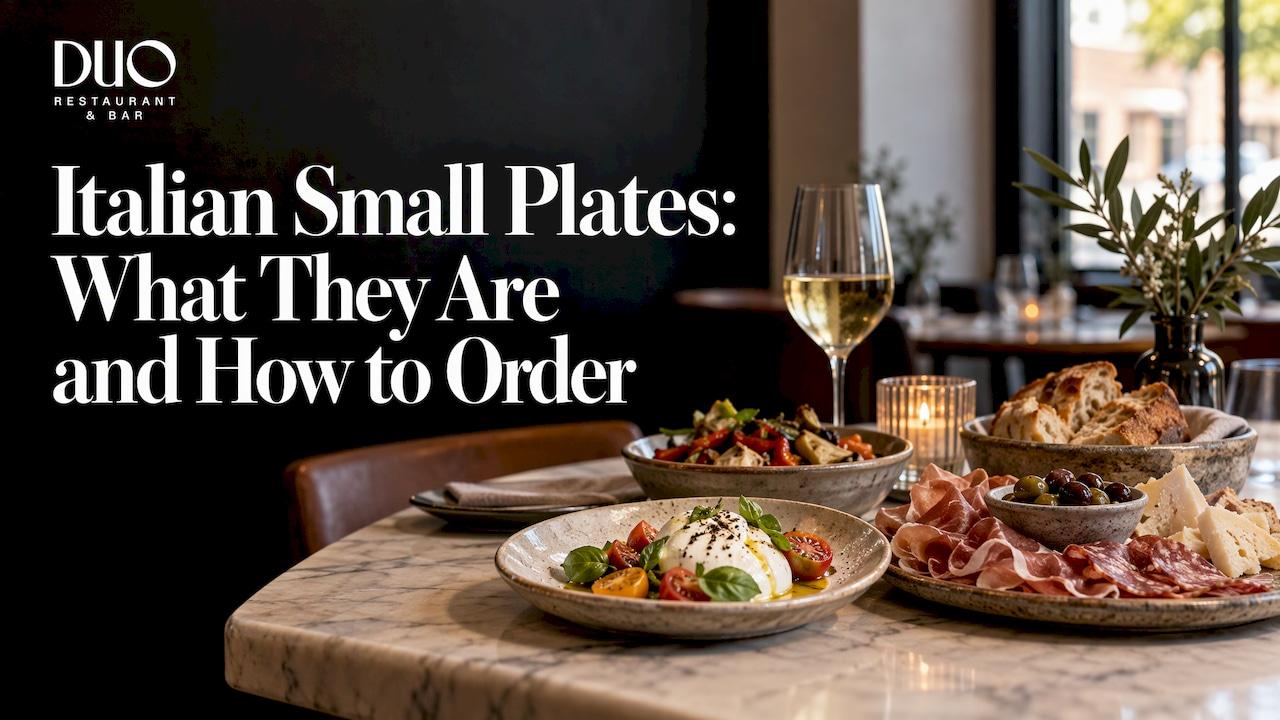
Italian small plates are shared starters and bites: antipasti at the start of a meal, and cicchetti, the little snacks of Venice's wine bars. The best way to enjoy them is to order several for the table, let them arrive together, and save room for pasta. At Duo Restaurant & Bar in Haddon Township, our scratch kitchen builds creative small plates around fresh, seasonal ingredients, so you can eat this way close to home.
TL;DR
- "Italian small plates" is not one dish or one tradition. It covers antipasti (the first course) and cicchetti (Venetian bar snacks).
- Order for the table: a party of four might choose three or four dishes and share them, then each person gets their own pasta or main.
- Small plates are meant to whet the appetite, not replace dinner, unless you decide to make them the whole meal.
- At Duo, plates and bites are $12 on our happy hour menu, alongside $8 wine by the glass and signature cocktails.
- Groups can build a whole evening around sharing, from a casual table to a private event.
Table of Contents
- What Italian small plates really mean
- Cicchetti: the Venetian way
- Antipasti: the first course
- How to order and share small plates
- Fitting small plates into a full Italian meal
- Pairing small plates with drinks
- Our perspective on small plates
- Enjoy small plates at Duo
- Small plates for groups and gatherings
- What to look for in a good small plates menu
- FAQ
- Sources
What Italian small plates really mean
If you search for Italian small plates, you will find recipes for mini pizzas, stuffed artichokes and caprese skewers. Those are all fair answers, but the phrase hides two distinct traditions, and knowing the difference makes ordering easier.
The first is the antipasto, plural antipasti. It is the traditional first course of a formal Italian meal, usually made of bite-size portions and presented on a platter from which everyone serves themselves to stimulate the appetite. The word comes from the Latin for "before" and "meal," and antipasti often resemble what you would put on a charcuterie board: cheese, cured meats, olives, dips, vegetables, salads and bread.
The second is cicchetti, the small snacks and side dishes served in Venice's traditional bars, called bacari. They are eaten standing up, with a glass of wine, and they are a way of socializing as much as a way of eating.
In the American restaurant world, "small plates" has become a catch-all for both. A menu of shareable dishes that arrive when they are ready, meant to be passed around, is the modern version of what Italians have done for centuries.
Cicchetti: the Venetian way
Cicchetti are the closest thing Italy has to what Americans call tapas. They include polpette (fried meatballs), crostini, small sandwiches on crusty rolls, triangular tramezzini, and pickled, baked, stuffed or sauced seafood and vegetables. Classic Venetian examples are crostini with creamed salt cod (baccalà mantecato), hard-boiled eggs with anchovy paste, deep-fried artichokes, small crabs and sardines.

The tradition is as much about pace as food. The Venetian habit is to stop at several bars in an afternoon, taking a glass and a few bites at each, then moving on. Six to eight cicchetti make a meal, and because each costs only a couple of euros, you can taste widely without committing to a big plate.
That last point is why the idea travels so well. Small plates let you try the flavors you would normally skip. You might not order a whole entree of seafood, but you will happily try a bite of it on a crostino.
Seafood sits at the heart of the Venetian tradition, and it is a theme we care about too. When it is available, we source seafood from Long Beach Island, which gives our kitchen a local, seasonal answer to the briny, fresh flavors that cicchetti celebrate.

Antipasti: the first course
The antipasto course remains fundamental to Italian dining, in large part because of old beliefs about digestion and preparing the stomach for the foods and temperatures to come. A traditional antipasto platter includes an assortment of salumi such as prosciutto crudo, culatello and salame, together with olives, crostini or fried polenta squares topped with sauces or pâtés, and deviled eggs.
Antipasti can be hot, warm or cold. They might be as simple as a bowl of olives, or they might involve seafood, pickled vegetables, cheeses, bruschetta or small fried bites. What they share is that they favor sharp, bright flavors over large quantities. The point is to wake up the palate.
A useful note on the word itself: antipasto does not mean "before the pasta." It means before the meal, which is why the course is best thought of as the starter, classically paired with a dry sparkling wine like Prosecco.
You may also hear the word spuntini. It is a broader term, covering anything eaten in smaller quantities before a meal or as a snack, including pizza, soup or dessert. So an Italian small plate can be nearly anything, as long as the portion is modest and meant to be shared.
How to order and share small plates
The rhythm matters more than the menu. Here is the approach that works in Italy and at a table in South Jersey.
- Order for the table, not for yourself. In Italy, antipasti are ordered for everyone: a party of four might choose three or four dishes that arrive together in the center of the table. Groups commonly share a few antipasti family style, then each person gets their own pasta or main course.
- Aim for variety. Pick something fresh or cold, something fried or hot, and something from the sea or the garden. Sharing family style encourages variety and keeps any single dish from becoming the whole meal.
- Start with a drink. The antipasto course is traditionally a companion to an aperitivo. A glass of something sparkling or crisp, or a cocktail, sets the tone while you decide what comes next.
- Let the plates land together. Small plates are meant to sit in the middle of the table. Pass them around and take a little of each, so everyone tastes everything.
- Pace yourself. Order a first round, talk, then decide whether to add more or move on to pasta. You can always order again; you cannot un-order.
If you want a deeper look at the idea of passing plates, our guide to family style Italian dining covers what it means and the options available.
Fitting small plates into a full Italian meal
An Italian restaurant menu typically runs in order: antipasti, then primi, secondi and contorni, and finally dolci, caffè or a digestivo. Primi are usually pasta, rice or soup, secondi are the meat or fish mains, and contorni are the vegetable sides.
Two practical rules help you build a balanced evening:
- Small plates first, then pasta. Antipasti are "little bites" for enjoying while you arrive and visit with friends. In Italy they are not intended to be the meal, unless they are the meal, as with a grande antipasto of ten or more dishes.
- Keep contorni with the main. Italians reserve contorni for accompanying the secondo, though ordering one as a starter is quite acceptable. The tradition is not to eat salad and pasta together.
You do not have to follow every rule. At a neighborhood restaurant, the most common and most enjoyable approach is a hybrid. Share two or three small plates, then give everyone a pasta of their own. Or skip the main course altogether and order four or five small plates for the table, along with a drink or two.
How much to order depends on appetite and company. As a rough guide drawn from the Italian custom, one or two shared plates per person works well as a first course, while three or more per person makes a full meal on its own.
When you are planning a larger table, the same idea scales up, and family style dinners show how sharing platters can feed a big group without anyone feeling rushed.
Pairing small plates with drinks
Because small plates are built to be shared and sipped alongside, the drink matters. Classic pairings begin with Prosecco or a dry white wine, and in Venice the house white by the glass is the standard companion to cicchetti.
At Duo, our bar gives you more options than a single glass of white. We pour signature cocktails, a curated wine list and 18 craft beers on tap. Our happy hour menu lists signature cocktails at $10 to $12, wine specials at $8 per glass, and plates and bites at $12.
A few ideas for matching:
- Salty, cured or fried bites go well with something bright and sparkling.
- Seafood plates pair naturally with crisp whites.
- Richer, meatier bites suit a medium-bodied red or a malty craft beer.
- A well-balanced cocktail can bridge several different plates on the table.
For a closer look at matching flavors, see our practical guide to food and cocktail pairing, or our piece on planning a wine pairing dinner if you want to take it further.
Our perspective on small plates
We opened Duo in 2026 as a family-owned neighborhood spot, from the same team behind Il Villaggio in Cherry Hill. Small plates are the way we like to eat, and the way we like to host.
The reason is simple. A table of shared plates turns dinner into a conversation. Nobody is locked into a single dish, everyone tries something new, and the evening unfolds at its own pace. That is how Italian tables have always worked, and it is what we wanted in our dining room.
What makes it work for us is the scratch kitchen. We prepare nearly all of our menu items in-house, with fresh, seasonal ingredients, and our pastas are handcrafted. When there is seafood from Long Beach Island, we bring it in. A small plate is only as good as its ingredients, because there is nowhere to hide on a few bites.
We also built the room for sharing: modern-rustic, warm and without formality, with a full bar behind it. Come with friends, order a few plates for the middle of the table, and see where the night goes. Come hungry, leave inspired.
Jay
Enjoy small plates at Duo
If you are in Haddon Township, Haddonfield, Collingswood, Haddon Heights or anywhere nearby, you do not need a trip to Venice to eat this way. Our scratch kitchen serves creative small plates alongside housemade pastas, premium domestic meats and seasonal seafood, and our happy hour menu lists plates and bites at $12, wine by the glass at $8 and signature cocktails at $10 to $12.

You can browse the full menu to plan your order, then reserve a table for date night, a dinner with friends or a casual group night out.
Small plates for groups and gatherings
Sharing works for two people, and it works even better for ten. Small plates are among the easiest ways to feed a group because they remove the pressure of everyone choosing a single entree, and they give guests something to talk about.

For private gatherings, we offer private dining and a set of event menus. Event Menu 1 is $36 per person, Event Menu 2 is $51 per person, and our Elegant Cocktail Reception is $51 per person. If you want something more elaborate, our Chef's Menu is $98 per person. You can see details on the pages for Event Menu 1, Event Menu 2 and the Chef's Menu, or explore private dining for small celebrations near Haddonfield.
A few planning tips for a group:
- Think in rounds. Plan a first wave of cold and light plates, then something warm, then pasta or mains.
- Count dishes, not people. For a table of eight, five or six plates make a generous opening round.
- Offer a mix. Include vegetarian options, seafood and something familiar so every guest finds a favorite.
- Mind dietary needs. Tell us about allergies when you book so the kitchen can plan around them.
If the occasion is seasonal, such as a holiday meal, our Thanksgiving menu is another way to gather without cooking. And a gift card makes an easy present for anyone who loves a night out.
What to look for in a good small plates menu
Whether you are at Duo or exploring elsewhere, a few signs tell you a kitchen takes small plates seriously.
- Seasonality. Small plates showcase single ingredients, so they taste best when those ingredients are in season. Our guide to seasonal restaurant menus explains how to read them.
- Made in-house. Crostini, meatballs, pastas and sauces made from scratch taste different from assembled ones.
- A range of textures and temperatures. Antipasti can be hot, warm or cold, and a thoughtful menu uses all three.
- Portions built for sharing. Plates that split easily among a few people keep the table moving.
- A bar that matches. Wine, beer and cocktails chosen to go with the food make the whole experience feel considered.
If you like the sound of a menu that blends tradition with a lighter touch, our piece on modern Italian dining explains how to choose, and our take on Italian comfort food covers the heartier side of the menu.
FAQ
What are Italian small plates called?
The most common names are antipasti, the first-course starters of an Italian meal, and cicchetti, the small snacks served in Venetian bars. Spuntini is a wider term for any small bites eaten as a snack or before a meal. On American menus they are usually just called small plates, shared plates or appetizers.
How many small plates should we order?
In Italy, a party of four might choose three or four antipasti to share before pasta. If the small plates are the whole meal, plan on more: in Venice, six to eight cicchetti make a meal for one person. Start with a first round and add more as the table decides.
Are Italian small plates the same as antipasti?
Not exactly. Antipasti are a specific first course in a traditional Italian meal, while small plates is a broader modern term that can include antipasti, cicchetti and other shareable dishes. A small plate can be served at any point in the meal, and in some restaurants it is the whole meal.
Can I make a full dinner out of small plates at Duo?
Yes. Many guests share several plates for the table, then add pasta, or simply order a few rounds of plates with a drink. Our happy hour menu lists plates and bites at $12, and our full menu is on our website. You can make a reservation for your party.
Sources
- When in Venice, Eat Like a Venetian, The New York Times
- How to Order Like a Local in Italy, Food & Wine
- Traditional Italian Antipasti, Great Italian Chefs
- 24 Essential Words and Phrases to Know at an Italian Trattoria, Mashed