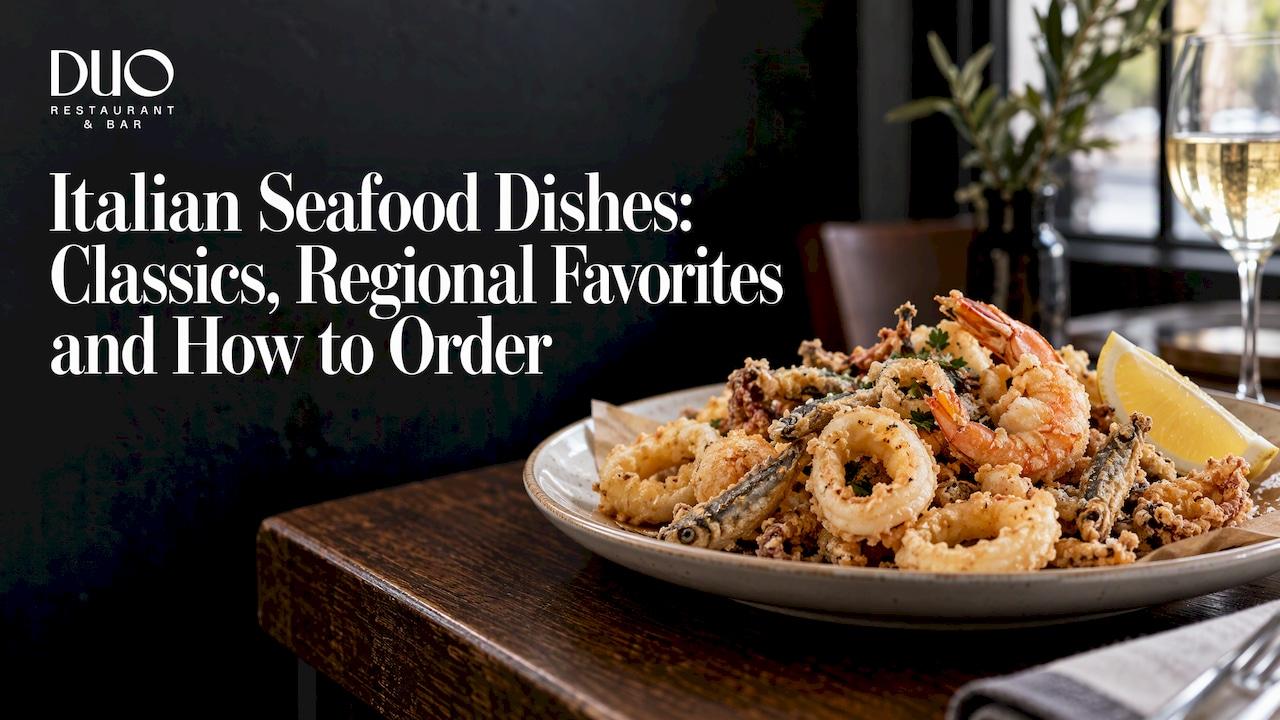
Italian seafood cooking is built on a simple idea: a few very fresh ingredients, treated with restraint. Clams, garlic, parsley and good olive oil make a dish. A tomato-and-garlic fish stew, a plate of lightly fried squid and shrimp, or a pan of linguine with mussels and calamari each tell you something about the coast they come from. This guide walks through the dishes worth knowing, how they differ by region, and how to order them with confidence. If you live around Haddon Township, it also shows where scratch cooking and seafood from Long Beach Island come together at our table.
TL;DR
- The classics to know are linguine alle vongole, fritto misto, risotto alla pescatora, linguine allo scoglio and a tomato-based fish stew.
- Italy's seafood is regional: Venice favors sweet-and-sour sardines, Tuscany and Liguria favor stews, Sicily favors swordfish and sardine pasta.
- Freshness matters more than complexity, so ask what came in recently and order the dish built around it.
- We cook from scratch at Duo in Haddon Township and use seafood from Long Beach Island when it is available.
- Many of these dishes are made for sharing, which suits a date night or a casual table of friends.
Table of Contents
- The Italian seafood dishes most people order
- How Italian seafood changes from region to region
- Cioppino: the Italian-American cousin
- What about the Feast of the Seven Fishes?
- How to order Italian seafood well
- Why a scratch kitchen changes seafood
- Who these dishes suit best
- Seafood night at Duo
- Our perspective
- FAQ
- Sources
The Italian seafood dishes most people order
If you only learn five, learn these. They show up on seaside menus across Italy and on Italian-American menus here, and each one teaches you a different technique.
Linguine or spaghetti alle vongole
Clams, pasta and parsley. According to Tasting Table's guide to classic Italian fish dishes, this dish is ubiquitous on Italian seaside menus, credited to Naples but served widely in Venice too, and the secret is plenty of fresh clams and a generous hand with parsley. The best versions finish the pasta in the pan with the clam liquor, so the sauce clings to every strand instead of pooling on the plate. It is also the easiest dish to judge: if the clams taste of the sea and the pasta is still springy, the kitchen knows what it is doing.
Fritto misto di mare
A mixed fry. The same Tasting Table piece describes squid rings, prawns and anchovies in a light batter of rice flour or semolina and white wine. The point is crispness without heaviness. It arrives hot, with lemon, and it is meant to be shared and eaten right away. This is the natural opening plate for a group.
Risotto alla pescatora
The fisherman's risotto. Tasting Table notes it uses carnaroli or arborio rice, white wine, aromatics, broth, butter and local fish, often shellfish. The rice drinks in the seafood broth, so the flavor runs through every grain. It is slow, patient cooking, the kind a scratch kitchen does well.

Linguine allo scoglio
Pasta "of the rock," loaded with shellfish. Antonio Amato calls it a symbolic Italian summer dish, and his four-person recipe pairs 350 g of linguine with mussels, clams, shrimp and calamari, plus cherry tomatoes, garlic, parsley and chili. He also notes that squid, octopus or cuttlefish can be swapped in or added. That flexibility is the real lesson: allo scoglio follows what the boats brought in.
Sicilian swordfish
A meatier option for people who think they do not like fish. Tasting Table describes it cooked with olives, garlic, cherry tomatoes and pine nuts, a combination that is salty, sweet and bright at once. Swordfish stands up to bold sauces, which makes it a good bridge between the seafood and meat sections of a menu.
How Italian seafood changes from region to region
Italy has a long coastline and no single seafood tradition. What lands on the plate depends on the water, the history and, often, what poor fishing families could afford.
Veneto. Salt cod, called baccalà, is a Venetian staple. Tasting Table explains that baccalà alla vicentina pairs dried salted cod with fried onions and anchovies, a reminder that salt was how fish traveled inland before refrigeration.
Marche. The port of Ancona is famous for brodetto, a chunky tomato-based fish stew. Ancona Tourism says the traditional recipe calls for 13 different kinds of fish and shellfish, cooked with onion, garlic, parsley, tomato puree and vinegar, then ladled over slices of homemade bread.
Tuscany. Visit Tuscany highlights spaghetti alla trabaccolara from Viareggio, named after a fishing boat, with cut fish cooked in oil, onion, garlic and fresh tomato. It also describes polpo all'elbana, Elba-style octopus, as summer comfort food: boiled about 30 minutes, cut up and dressed with very good extra virgin olive oil and fresh chili.
Liguria. This is the home of ciupin, a humble stew of inexpensive local fish on a tomato and garlic base, served with toasted bread. Hold that thought, because it is the grandparent of a dish many Americans already know.
Sicily. Tasting Table points to swordfish, and the island's pasta con le sarde, with sardines, wild fennel, raisins and pine nuts, shows how many cultures have passed through its kitchens.

A quick way to use this: when a menu offers a stew or a fry, ask which style it follows. Tomato-forward and bread-served points to the central coast. Lemon, oil and very little else points to the south.

Cioppino: the Italian-American cousin
If you have eaten cioppino, you have already met Ligurian cooking. A 1988 New York Times piece describes San Francisco's cioppino as crab, shrimp, clams and firm-fleshed fish with onions, garlic, tomatoes and herbs cooked in olive oil and wine, and traces the name to ciuppin in the dialect of Genoa. It also places it in a family of fish stews that includes Livorno's cacciucco and the thick brodetto of the Marches.
The difference is mostly abundance. In Liguria the stew was made from modest fish; in the American version, immigrants found crab and shellfish plentiful and put them in the pot. Same tomato, same garlic, same bread alongside, bigger bowl.
What about the Feast of the Seven Fishes?
Many readers arrive here around the holidays asking about the seven fishes. It is best understood as an Italian-American Christmas Eve tradition rather than a fixed Italian menu. Families choose their own seven, commonly drawing on dishes like clams, baccalà, calamari, shrimp and mussels, and the lineup changes from house to house. That is good news if you are planning one: there is no wrong list, only the dishes your table loves. Pick a mix of textures, something fried, something in broth, something pasta-based, and you have the shape of it.
How to order Italian seafood well
A few habits make every seafood dinner better, whether you are at a neighborhood spot or a destination restaurant.
- Ask what is freshest. Seafood-focused kitchens change what they offer with what arrives. A server who can tell you what came in, and from where, is a good sign.
- Match the dish to the mood. Brothy stews and risotto feel cozy and slow. Fritto misto and crudo-style plates feel lively. Pasta with shellfish sits in the middle.
- Share the starters. Seafood is generous when it is split. A fried plate and a small plate of something marinated or grilled across the table lets everyone taste more.
- Do not over-sauce. If you are ordering a delicate fish, skip the heavy extras. Lemon, olive oil and a little herb usually beats cream.
- Pair it deliberately. Crisp, dry whites and light, bright reds suit most seafood. Our guide to Italian food and wine pairing covers the basics for dinner.
If your table includes someone who wants meat instead, our overview of Italian meat dishes helps everyone find something. And if you like to build a meal from several smaller plates, see how to order Italian small plates.
Why a scratch kitchen changes seafood
Seafood is unforgiving. A clam cooked a minute too long turns rubbery; a sauce built from a jar tastes flat next to the sweetness of fresh shellfish. The dishes above work because each step is done by hand, in order, at the right moment: the garlic softened gently, the wine reduced, the pasta finished in the pan with the sauce.
That is how we cook at Duo. We prepare nearly everything in-house, with fresh, seasonal ingredients, and we bring in seafood from Long Beach Island when it is available. Handcrafted pasta and seafood are a natural pair, and we think of them as the heart of what homemade Italian food means. You can read more about that in our piece on homemade Italian food, and about how a changing menu works in our guide to seasonal restaurant menus.
Because availability follows the boats and the season, the seafood on any given night can vary. That is the nature of cooking this way, and it is part of the fun of coming back.
Who these dishes suit best
Date night. Share a fried starter, then split a seafood pasta and a second main. Add a glass from our wine list, and you have an unhurried dinner without the formality.
Friends and small groups. Seafood dishes are made for the middle of the table. Order several, pass them around, and let the bread soak up the sauce.
Families. Pasta with a gentle seafood sauce is an easy first step for kids who are curious, and a fried plate is usually a hit.
Locals who want a neighborhood Italian. If you are in Haddonfield, Collingswood, Haddon Heights, Audubon or Oaklyn, you do not need to travel far for a good plate of pasta and a drink. Our guide to modern Italian dining explains the style we aim for.
Seafood night at Duo
We are a family-owned neighborhood spot in Haddon Township, from the same team behind Il Villaggio in Cherry Hill, and we opened in 2026. Our kitchen is scratch-made, our bar pours signature cocktails and 18 craft beers on tap, and our wine list is thoughtfully curated.
For a special evening, our Chef's Menu is $98 per person. If you would rather keep it casual, our happy hour menu lists signature cocktails at $10-12, wine specials at $8 per glass and plates and bites at $12. Browse the full menu to see what is on right now.

Planning something bigger? Our private dining is a good fit for small gatherings near Haddonfield, and our event menus start at $36 per person.
Our perspective
We think the best seafood dinners are the least complicated ones. The Italian dishes that have lasted for generations, a pan of clams and pasta, a crisp mixed fry, a stew ladled over bread, all rely on the same thing: ingredients that taste like themselves, handled with care.
That is why we cook from scratch. When the pasta is handcrafted and the sauce is made in our kitchen, there is nowhere for a dish to hide, and that is exactly how we like it. When we can get seafood from Long Beach Island, we want it to be the star, and we build the plate around it.
We also believe good food should feel easy. You should be able to walk in on a weeknight with friends, share a few plates, have a glass of wine or a craft beer, and leave feeling like a neighbor, not a guest at a formal affair. Come hungry, leave inspired.
Jay
FAQ
What is the most popular Italian seafood dish?
It depends who you ask, but spaghetti or linguine alle vongole is on seaside menus nearly everywhere in Italy, and fritto misto and seafood risotto are close behind. Together they give you a pasta, a fry and a rice dish, a good mix for a first dinner.
What is the difference between cioppino and Italian fish stew?
Cioppino is the Italian-American descendant of Liguria's ciupin. Both are built on tomato and garlic, but the American version leans on crab, shrimp and clams, while Italian stews like brodetto or cacciucco use a wide mix of local fish and are served over bread.
Is the Feast of the Seven Fishes a traditional Italian menu?
It is generally described as an Italian-American Christmas Eve custom, and there is no single fixed list of seven. Families pick their own dishes, so build yours around the seafood you like best.
Does Duo serve seafood from Long Beach Island?
Yes, we use seafood from Long Beach Island when it is available, alongside fresh, seasonal ingredients in our scratch kitchen. Our full menu shows what we are cooking right now.
Can I book a group dinner?
Yes. We offer private dining for small gatherings, along with event menus priced per person, and our team can talk through what suits your group.
Sources
- 14 Classic Italian Fish Dishes, Tasting Table
- The typical fish dishes of Ancona cuisine, Ancona Tourism
- 5 traditional seafood dishes, Visit Tuscany
- Cioppino: Fish Stew From the Pacific, The New York Times
- Linguine allo scoglio, Antonio Amato