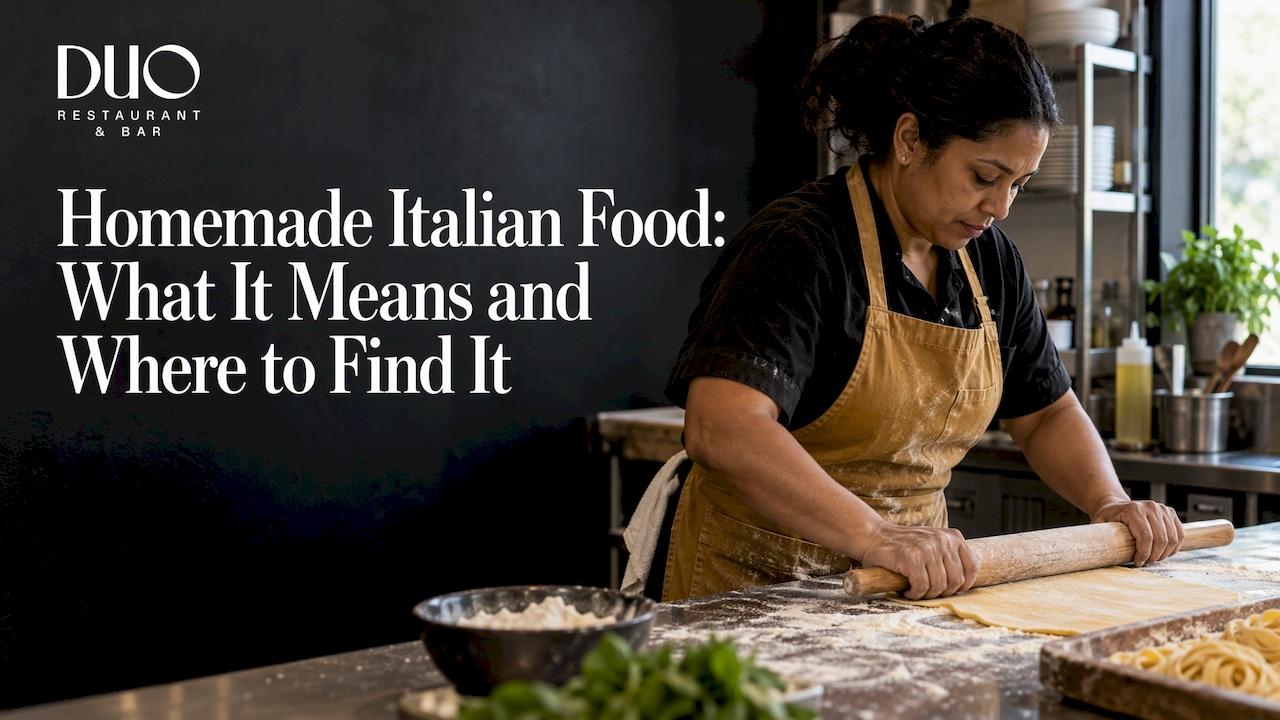
Homemade Italian food is cooked from scratch, in small batches, around a few ingredients of the best quality you can find: pasta shaped by hand, sauces built from real tomatoes and aromatics, and fish or produce chosen for the season. If you live around Haddon Township, Haddonfield or Collingswood and want that kind of dinner without cooking it yourself, we serve it every night at Duo Restaurant & Bar, where nearly everything on the menu is prepared in our own kitchen.
This guide explains what the phrase really means, which ingredients and habits create the flavor, how a proper Italian dinner unfolds, and how to order for a date night, a family table or a group of friends.
TL;DR
- Homemade Italian food means a scratch kitchen: pasta, sauces and sides made in-house rather than reheated or assembled.
- Flavor comes from a short list of excellent ingredients, cooked with simple technique and seasoned at the right moment.
- A traditional Italian meal moves from small starters to pasta to a lighter main course, so you can order in that order and share along the way.
- At Duo in Haddon Township we cook this way, with handcrafted pastas, seasonal seafood from Long Beach Island when available, a full bar and 18 craft beers on tap.
- Small groups can book private dining, with event menus listed from $36 per person.
Table of Contents
- What "homemade" really means on an Italian menu
- The ingredients and habits behind the flavor
- How a homemade Italian dinner unfolds
- Seasonal cooking and seafood from Long Beach Island
- What to order for your occasion
- Planning a group dinner or small private gathering
- Book your table at Duo
- Our point of view
- FAQ
- Sources
What "homemade" really means on an Italian menu
The word gets used loosely, so it helps to define it. At a restaurant, homemade means the kitchen makes the foundations itself: the dough, the sauces, the stocks, the dressings and the desserts. Dishes are cooked to order from those foundations. It does not mean a rustic look or a red-checkered tablecloth. It means the work happened in the building before you arrived.
That is also the heart of the tradition. Writer Robert Iulo, recalling the cooking of his grandmother from Salerno, separates family cooking from restaurant-style Italian-American dishes. In his telling, the home table meant dozens of sauces, each paired in strict combination with a particular pasta shape, and Christmas Eve fish meals built around squid, octopus and baccalà (dried cod soaked for days). Knowledge was passed down by watching and doing in the kitchen, not from a written recipe.
Italian-American cooking grew out of that same memory. PBS describes it as old taste memories translated into new realities, shaped by the ingredients and ambitions immigrants found here. That is why a homemade Italian menu in New Jersey can honor tradition and still feel local. The ingredients change a little with the place and the season, and the care stays the same.
For a deeper look at how this style feels at the table, our guide to Italian comfort food covers the dishes people crave on a cold night, and our piece on what a scratch kitchen restaurant is shows how to recognize one.
Quick signs you are eating scratch-made food
- The pasta has texture and a slight chew, and the sauce clings to it instead of pooling on the plate.
- The menu changes a little with the seasons, and the server can say where the fish came from.
- Starters, sauces and desserts have a distinct flavor of their own rather than a uniform sweetness or saltiness.
- The list of dishes is focused. A kitchen that makes everything itself tends not to offer everything.
The ingredients and habits behind the flavor
Italian cooking is often called simple, and that is the point. With few ingredients, each one has to be good. Food writer Anna Del Conte put it plainly in her ten commandments of Italian cooking: the success of the cuisine rests on the flavor of the key ingredient, which must be of the highest quality.
Olive oil, tomatoes, garlic and cheese
A typical Italian pantry, as described by chefs in Real Simple, includes olive oil, vegetables, garlic and onion, fish, balsamic vinegar, Grana Padano or Parmigiano-Reggiano, cured meats and starches. The same article quotes Lidia Bastianich saying Italian flavors are at their best when they rest on seasonality and locality, and Michael Chiarello adds that the cuisine celebrates produce, with protein often an afterthought.
Tomatoes deserve a special mention. Serious Eats notes that the tomato is an American crop that did not reach Italy until around the turn of the 15th century, yet tomato sauce has become the most important preparation in Italian cooking. It can come from fresh or canned tomatoes, with or without aromatic vegetables, and be quick-cooked or simmered for hours. A good kitchen picks the method to suit the dish.
Technique that shows on the plate
The simplest dishes expose the cook. The same Serious Eats guide points to aglio e olio, pasta with garlic and olive oil, as a test of technique: pasta cooked just right, water seasoned well, and a splash of starchy pasta water used to turn the oil into a creamy sauce that is rich but not greasy. The garlic is cooked gently so it never turns bitter.
Small habits matter too. Del Conte recommends a tall cylindrical pot for pasta so the water returns to a boil quickly, earthenware for ragù and stews so the heat stays even, and sea salt added at the start so it dissolves properly. None of this is glamorous. All of it can be tasted.
Fresh pasta, made by hand
Pasta is the center of a homemade Italian dinner. Real Simple's guide says to buy the best pasta you can afford or make your own from flour, water, egg and olive oil. A handcrafted pasta has a surface that grips sauce and a bite that dried shapes do not always match. At Duo we make our pastas by hand in-house, and the sauces are cooked to go with them, the way the tradition intends.
How a homemade Italian dinner unfolds
An Italian meal is a sequence, and ordering with that sequence in mind makes the evening better. Chiarello describes it in Real Simple as starting with antipasti, such as marinated mushrooms, artichoke hearts and cured meats, followed by a small pasta and a light protein. The meal grows simpler as it goes, a "reverse crescendo" in his words.
In a restaurant, that rhythm looks like this:
- Something to share first. Small plates arrive while drinks are poured. Our guide to Italian small plates explains how to build a table of starters.
- Pasta as its own course. A portion sized to be enjoyed, not to end the night.
- A lighter main. Fish, a roasted or grilled meat, or a vegetable-led dish. If you lean toward meat, the rundown of Italian meat dishes will help you choose.
- Something sweet and a coffee. Dessert is a pause, not an afterthought.
You do not have to order every course. Two people can share two starters, a pasta each and one main between them, and leave satisfied. Groups often prefer to pass dishes around, which is the spirit of family style Italian dining.
Chefs who write about this tradition also see it evolving. Restaurants today keep regional dishes and adapt them with modern techniques and local produce, a movement covered in gastronomy trends for 2026. If that interests you, our overview of modern Italian dining shows how the old and new fit together.

Seasonal cooking and seafood from Long Beach Island
Seasonality is not a marketing word in Italian kitchens. It is how menus are decided. Bastianich's summer cooking guide describes no-cook tomato sauce from sun-ripened garden tomatoes marinated with olive oil, garlic and peperoncino, and grilled swordfish, halibut or tuna rolled in herbed breadcrumbs. Summer tastes like tomatoes and the grill. Winter leans toward braises, slow sauces and root vegetables.
For us in South Jersey, the local equivalent is the Jersey Shore. When it is available, we bring in seafood from Long Beach Island and let the season decide what goes on the plate. Fish treated simply, with good oil, lemon, herbs and a gentle hand, is as Italian as it gets, and it is the kind of dish that tastes best when it was in the water not long ago.
A seasonal menu also means the dish you loved last month may rotate out. That is a feature of cooking from scratch with what is good right now, and a reason to come back and try what is new.
What to order for your occasion
The same kitchen serves very different evenings. Here is how we would steer each of them.
| Occasion | How to order | Why it works |
|---|---|---|
| Date night | Share one or two small plates, then a handcrafted pasta each, and a glass of wine from the curated list | The meal has a natural pace and leaves room for conversation |
| Family dinner | Order several dishes for the middle of the table and let everyone taste | Children and adults find something they like, and the table feels lively |
| Casual night with friends | Start with cocktails or a pour from the 18 craft beers on tap, then share plates and pasta | Easy, social and relaxed, with no formal structure |
| Solo or quick bite | Sit at the bar for a small plate and a glass | Good food without committing to a full dinner |
| Seafood lover | Ask what came in from Long Beach Island | The freshest dish is often the one that changes with the season |
If you are planning a wine-led evening, our guide to pairing wine with Italian food lays out the logic, and beer drinkers will find the same approach in our piece on beer pairing dinners.
Drinks and happy hour
The bar is part of the experience. Our happy hour menu lists signature cocktails at $10 to $12, by-the-glass wine specials at $8 a glass and plates and bites at $12. You can see everything on our happy hour menu, which is an easy way to start a casual night out in Audubon, Oaklyn or Haddon Heights without planning too much.
A few dishes worth a closer look
Some classics reward a careful kitchen. Tiramisu is a good example: chef Gianluca Guglielmi explains that the real version uses mascarpone, espresso and pan di Spagna sponge. He also suggests ordering Caprese in summer, when heirloom tomatoes, buffalo mozzarella, fresh basil, good olive oil and sea salt come together. When the ingredients are right, the dish needs nothing else. The same principle applies to anything on our menu: choose what the season is offering and you will taste the difference.

Planning a group dinner or small private gathering
A homemade menu suits groups well, because sharing is built into the way the food is served. For a casual dinner in Haddon Township or Haddonfield with friends or family, a reservation for the whole table and a plan to pass dishes around is usually all you need.
For birthdays, rehearsal dinners and small celebrations, we offer private dining. Our event menus are priced per person: Event Menu 1 is $36 per person and Event Menu 2 is $51 per person. The Elegant Cocktail Reception is $51 per person, and the Chef's Menu is $98 per person for a fuller, multi-course evening.
One decision shapes a group meal more than most: whether to serve it plated or buffet style. Thinking through plated versus buffet service helps you match the format to the size and mood of your gathering. A plated meal feels more formal and keeps pacing under control, while shared platters feel closer to a family table, which is the feeling homemade Italian food does best.
Guests coming from Cherry Hill, Voorhees, Merchantville, Mount Ephraim, Barrington or Maple Shade will find us close at hand, and our guide to an Italian restaurant near Voorhees covers the drive and what to expect.

Book your table at Duo
We opened Duo in Haddon Township in 2026 as a family-owned neighborhood spot, from the same team behind Il Villaggio in Cherry Hill. The kitchen makes nearly everything in-house, from handcrafted pastas to our sauces, and the bar pours signature cocktails, a curated wine list and 18 craft beers on tap. You can browse the full menu before you come, or reserve a table for your next dinner. Gift cards are available too, for the person in your life who loves a good meal.

Our point of view
We opened Duo because we believe a neighborhood deserves a place where the food is made by people who care about it, and where you can walk in on an ordinary Tuesday and feel at home.
To us, homemade is not a slogan. It is the daily routine of a scratch kitchen: pasta shaped by hand, sauces cooked with patience, and seafood from Long Beach Island when it is available. We keep the menu approachable on purpose. Good Italian cooking has never needed to be complicated, and the table is better when everyone can relax and share.
Whether you come for date night, a casual round of drinks with friends or a small private gathering, our hope is the same: come hungry, leave inspired, and come back soon.
Jay
FAQ
What is the difference between homemade Italian food and typical Italian-American restaurant food?
Homemade Italian food is made from scratch, from the pasta to the sauces, using a limited number of high-quality ingredients. Italian-American cooking is a rich tradition of its own, shaped by immigrant ingredients and memories, and the best versions are cooked with the same care. What matters most is whether the kitchen makes things itself.
What dishes should I expect at a homemade Italian restaurant?
Expect small shared plates, handcrafted pastas, sauces such as ragù or simple tomato, and mains built around meat or fish. Menus lean on the season, so the choices shift through the year. You can see what we are serving on our full menu.
Is a homemade Italian dinner good for a date night?
Yes. The courses arrive at an unhurried pace, sharing small plates gives you something to talk about, and a glass of wine or a cocktail from the bar rounds out the evening. Reserving ahead helps you get the table and time you want.
Can I book a small private gathering near Haddonfield?
Yes. Duo offers private dining and event menus priced per person, starting at $36 per person. Details are on our private events page.
Do you serve seafood from Long Beach Island?
When it is available, yes. We build seasonal dishes around seafood from Long Beach Island, so the selection changes with what comes in.
Sources
- La Cucina Povera, Robert Iulo
- How Marcella Hazan rewrote the story of Italian food in America, PBS
- Ten commandments of Italian cooking, The Guardian
- Essential elements of authentic Italian cuisine, Real Simple
- How to Cook Italian Food Like an Italian, Serious Eats
- Lidia's Italy at Home, Italian-Style
- Italian restaurant ordering guide, Chowhound
- Trends in Gastronomy 2026
- Plated vs Buffet: How to Choose for Your Event